
In a digital-first world where speed, quality, and scalability determine success, software development can no longer afford disconnected workflows. Businesses today need solutions that are thoughtfully designed, seamlessly built, and continuously improved. This is where end-to-end (E2E) software development comes in. A holistic approach that manages the entire software lifecycle under one unified strategy.
From the earliest idea to post-launch optimization, end-to-end software development ensures consistency, accountability, and efficiency. Instead of juggling multiple vendors or fragmented teams, organizations work with a single partner that takes ownership of the complete journey, delivering software that aligns with business goals and user expectations.
What Is End-to-End Software Development?
End-to-end software development is a comprehensive model in which one team or vendor oversees every phase of the Software Development Life Cycle (SDLC). This includes discovery, design, development, testing, deployment, and long-term maintenance.
Unlike traditional siloed approaches, where different teams handle isolated stages, E2E development ensures continuity. The same vision that shapes the initial concept guides the final product, resulting in cohesive architecture, consistent user experience, and better long-term performance.
If your business is looking for a holistic approach to managing the entire software lifecycle, the digital experts at Gemini Consulting & Services can help. Contact us to receive a customized solution for efficient software development.
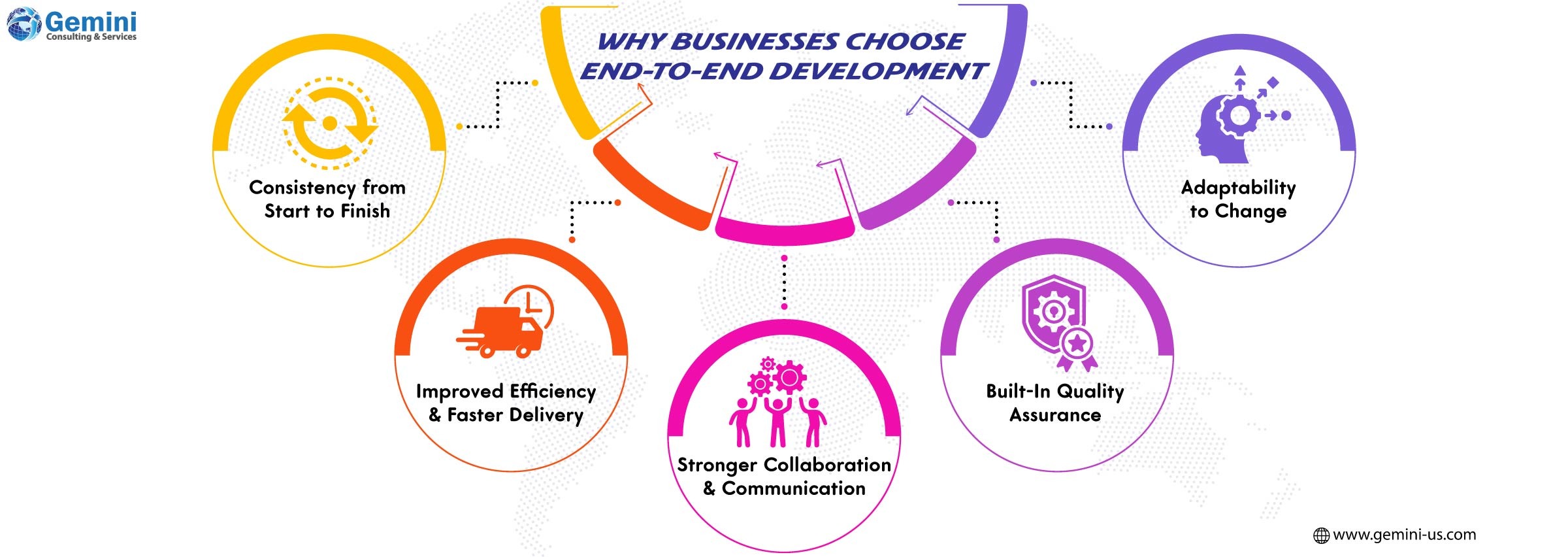
Consistency from Start to Finish
With a single team managing the entire lifecycle, the original vision remains intact. Design decisions, technical architecture, and feature prioritization all align with the initial business objectives.
Improved Efficiency and Faster Delivery
Eliminating handoffs between multiple vendors reduces delays and miscommunication. Teams work in parallel, making faster decisions and accelerating time-to-market.
Stronger Collaboration and Communication
Cross-functional teams of designers, developers, QA engineers, and DevOps specialists collaborate closely, enabling quicker problem-solving and more innovative outcomes.
Built-In Quality Assurance
Testing and quality control are integrated into every phase, not treated as an afterthought. This results in more stable, secure, and reliable software.
Adaptability to Change
E2E development supports agile practices, making it easier to incorporate user feedback, market changes, or evolving business needs without derailing the project.
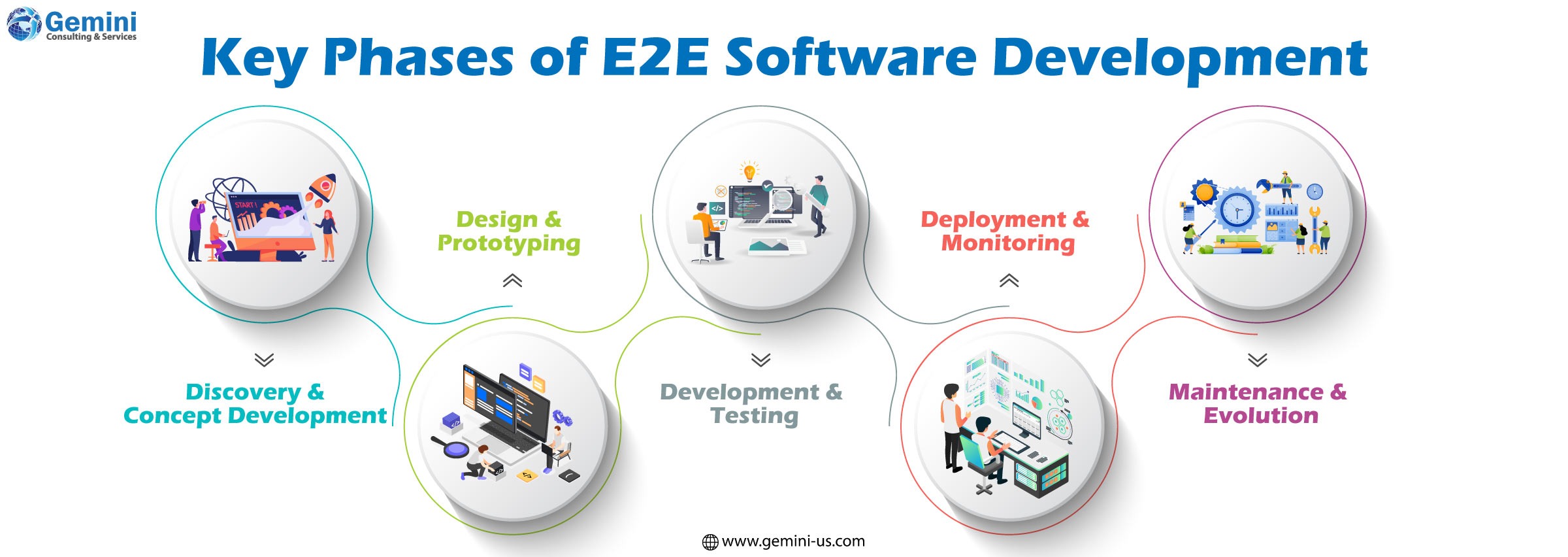
1. Discovery and Concept Development
Every successful product starts with clarity. This phase focuses on understanding the business problem, target audience, and competitive landscape. Stakeholder interviews, market research, and feasibility studies help define scope, goals, and success metrics.
2. Design and Prototyping
Designers translate ideas into visual and interactive experiences. UI/UX design, customer journey mapping, and clickable prototypes allow teams to validate assumptions early and gather feedback before development begins.
3. Development and Testing
Using agile methodologies, developers build the software in iterative cycles. Frontend and backend systems are integrated while continuous testing, often driven by test-first or test-driven approaches, ensures functionality, performance, and security at every stage.
4. Deployment and Monitoring
DevOps practices play a critical role here. Continuous Integration and Continuous Delivery (CI/CD) pipelines enable smooth, automated deployments. Post-release monitoring ensures the system performs reliably under real-world conditions.
5. Maintenance and Evolution
Software does not end at launch. Ongoing maintenance, updates, and enhancements are guided by a clear product roadmap and continuous user feedback, ensuring the solution remains competitive and scalable.
End-to-End vs. Fragmented Development Approaches
Fragmented development models often assign different vendors or teams to individual phases. While each group may perform well independently, the lack of cohesion can lead to misaligned priorities, integration issues, and inconsistent quality.
End-to-end development avoids these pitfalls by centralizing responsibility. With one accountable partner, businesses gain better visibility, fewer risks, and a more predictable outcome, especially important when outsourcing complex software projects.
Challenges to Be Aware Of
While E2E development offers clear advantages, it also comes with considerations:
- Higher upfront resource commitment, particularly during discovery
- Increased complexity for large, multi-stakeholder projects
- Risk of scope creep if changes are not carefully managed
These challenges can be mitigated through clear contracts, strong governance, and regular progress reviews.
Choosing the Right End-to-End Development Partner
Selecting the right outsourcing partner is critical to success. Key factors to evaluate include:
- Technical expertise in relevant technologies and domains
- Proven end-to-end experience, not just point solutions
- Strong communication practices and responsiveness
- Cultural alignment and collaboration mindset
- Robust security, IP protection, and quality standards
Reviewing portfolios, case studies, and certifications (such as ISO or CMMI) provides valuable insight into a partner’s reliability and maturity.
Outsourcing Models That Support E2E Development
- Staff Augmentation: Adds skilled professionals to your in-house team while retaining control.
- Managed Services: The partner takes responsibility for defined functions or the entire lifecycle.
- Project-Based Outsourcing: Ideal for fixed-scope projects with clear timelines and deliverables.
The right model depends on your internal capabilities, project complexity, and strategic goals.
Best Practices for Successful E2E Outsourcing
- Define clear requirements and success criteria upfront
- Establish change control and decision-making processes
- Maintain regular communication and feedback loops
- Track performance using KPIs like reliability, usability, and requirement fidelity
- Foster shared accountability between client and partner
Conclusion
End-to-end software development offers a powerful, integrated approach to building modern digital products. By unifying strategy, design, development, and operations under one accountable team, businesses gain consistency, speed, and long-term value.
For tech leaders navigating competitive markets, adopting an E2E model, supported by the right outsourcing partner, can transform ideas into scalable, high-quality software solutions that truly meet user and market demands.