
In an era marked by economic uncertainty, geopolitical tensions, labor shortages, and shifting customer expectations, supply chain disruptions have become a constant business challenge. Organizations can no longer rely solely on efficiency-driven models that prioritize cost reduction and lean inventories. Instead, they need resilient supply chains that can anticipate disruptions, adapt quickly, and recover with minimal impact.
A resilient supply chain is designed to withstand unexpected events while maintaining operational continuity. Rather than reacting to problems after they occur, resilient organizations use data, technology, and strategic planning to identify risks early and respond proactively.
Why Supply Chain Resilience Matters
Modern supply chains are highly interconnected, spanning suppliers, manufacturers, logistics providers, distributors, and customers across multiple regions. A disruption at any point in this network can affect the entire operation.
Whether caused by natural disasters, transportation bottlenecks, regulatory changes, inflation, or supplier failures, disruptions can lead to delays, increased costs, and lost revenue. As global supply chains become more complex, resilience has evolved from a risk-management function into a critical business strategy.
Organizations with resilient supply chains are better positioned to maintain customer satisfaction, protect profitability, and capitalize on market opportunities when competitors struggle to recover.
Research from the McKinsey Global Institute indicates that supply chain disruptions can cost businesses the equivalent of nearly 42% of a year's EBITDA over a ten-year period. As a result, resilience has become a critical strategic priority rather than simply a risk-management measure.
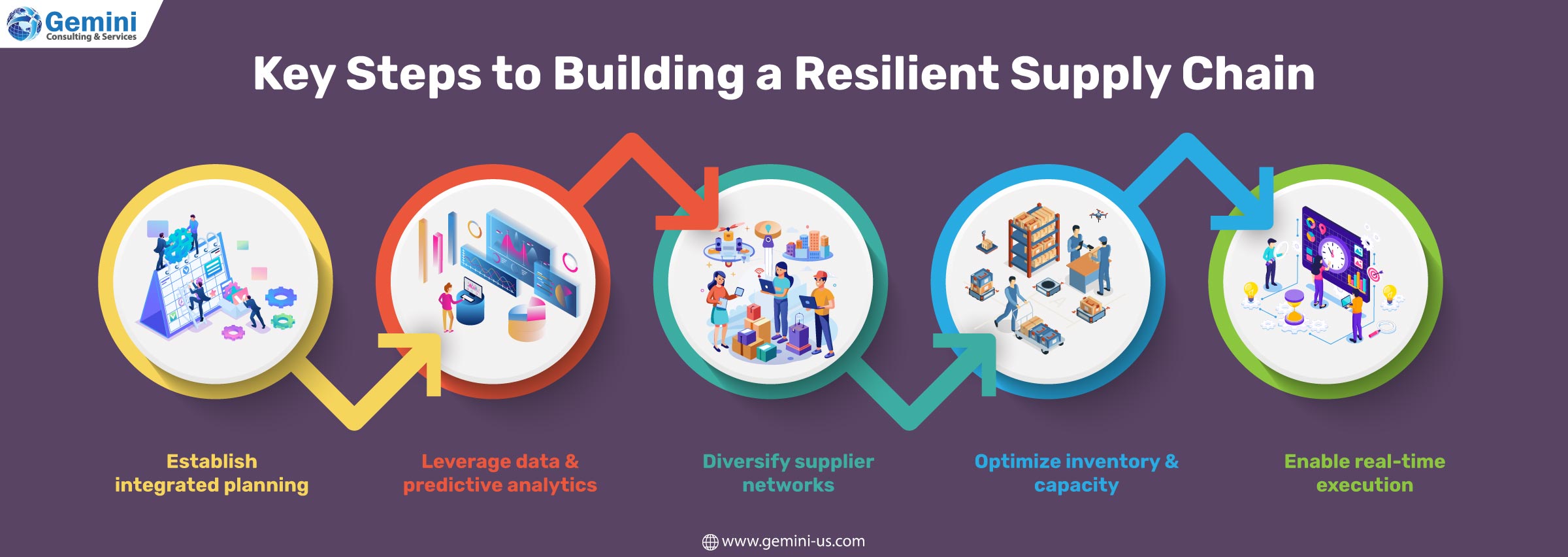
1. Establish Integrated Planning
Resilience begins with end-to-end visibility. Businesses should connect planning processes across procurement, manufacturing, logistics, sales, and operations to create a unified view of the supply chain.
Integrated planning allows organizations to identify risks earlier, understand their potential impact, and develop response strategies. Scenario modeling and simulation tools further help businesses prepare for multiple outcomes and make informed decisions during disruptions.
2. Leverage Data and Predictive Analytics
Data is the foundation of supply chain resilience. By consolidating information from suppliers, operations, and market demand, businesses can gain valuable insights into emerging risks and opportunities.
Artificial intelligence (AI) and predictive analytics help organizations detect anomalies, forecast disruptions, and recommend corrective actions before issues escalate. This proactive approach enables companies to reduce uncertainty and improve decision-making.
3. Diversify Supplier Networks
Overdependence on a single supplier or geographic region creates significant risk. Companies can strengthen resilience by diversifying their supplier base and exploring alternative sourcing strategies, including nearshoring.
It is equally important to monitor indirect suppliers, often referred to as Tier-2 and Tier-3 suppliers. Mapping these extended supplier networks helps uncover hidden vulnerabilities and ensures greater transparency throughout the supply chain.
4. Optimize Inventory and Capacity
Traditional “just-in-time” inventory models focus on efficiency but can leave businesses exposed during periods of disruption. A more resilient approach balances efficiency with preparedness by maintaining strategic inventory buffers and flexible production capacity.
Advanced forecasting tools help businesses align inventory levels with demand patterns, reducing both shortages and excess stock.
5. Enable Real-Time Execution
Automation and digital technologies allow organizations to respond quickly to changing conditions. Smart sensors, robotics, and modern enterprise systems provide real-time visibility into operations, helping businesses detect issues early and take immediate action.
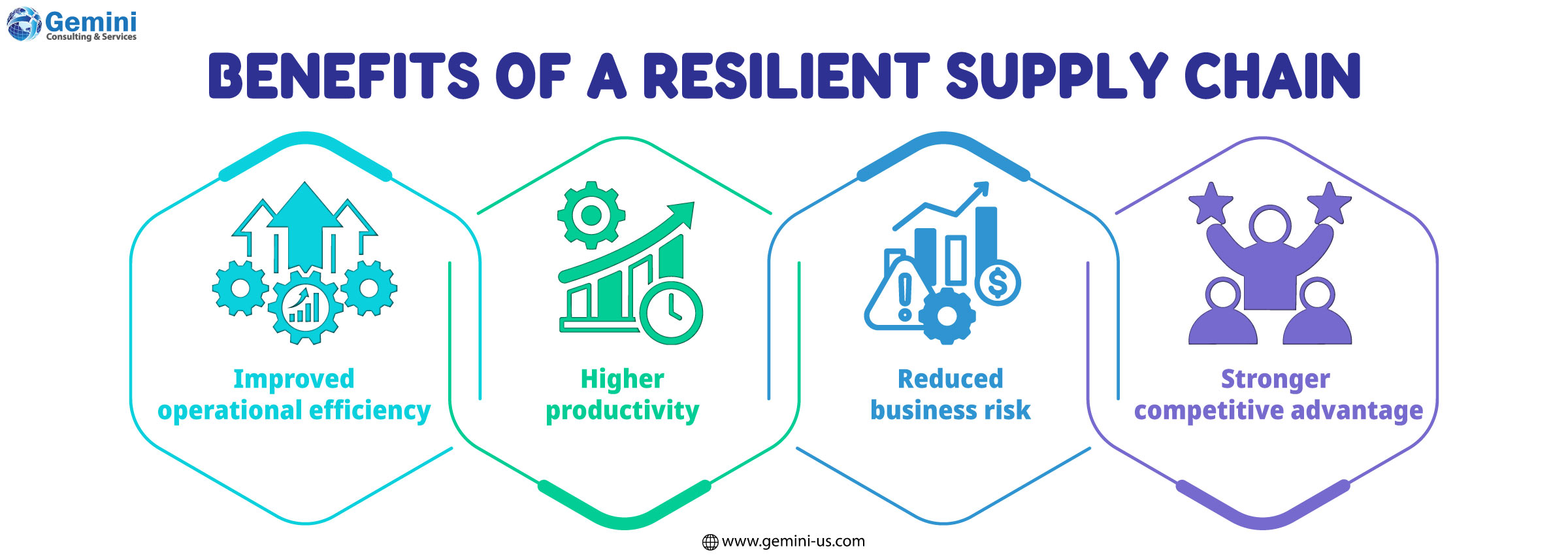
According to Bain & Company, organizations that invested in resilience were able to accelerate product development by up to 60% and boost their output capacity by as much as 25%.
Improved Operational Efficiency
Resilient organizations experience fewer disruptions and recover more quickly when challenges arise. This allows them to focus resources on innovation, growth, and customer service rather than crisis management.
Higher Productivity
Better planning, visibility, and automation improve productivity across the supply chain. Organizations can streamline processes, reduce waste, and meet customer expectations more effectively.
Reduced Business Risk
Real-time monitoring and early-warning systems help businesses identify risks before they become major problems. This reduces the likelihood of operational disruptions, financial losses, and reputational damage.
Stronger Competitive Advantage
Companies that invest in resilience often outperform competitors during periods of uncertainty. Their ability to adapt quickly enables them to maintain service levels, protect revenue, and capture market opportunities when others face setbacks.
Digital transformation plays a central role in building resilient supply chains. Several technologies help organizations improve visibility, agility, and decision-making.
Artificial Intelligence (AI)
AI analyzes large volumes of data from multiple sources, including demand trends, market conditions, weather patterns, and supplier performance. These insights help organizations identify risks and make proactive adjustments to sourcing, production, and inventory strategies.
Machine Learning (ML)
Insights from new data is an approach by which machine learning tools can improve forecasting accuracy. This enables businesses to adapt inventory levels and production plans as conditions change.
Industrial Internet of Things (IIoT)
IIoT connects machines, sensors, and equipment across manufacturing and logistics operations. Real-time monitoring of assets and shipments helps organizations improve efficiency, reduce downtime, and gain greater visibility into supply chain performance.
Additive Manufacturing
Also known as 3D printing, additive manufacturing provides greater production flexibility by enabling organizations to produce parts closer to demand locations. This reduces reliance on complex supply networks and shortens lead times.
Robotics and Automation
Automation improves speed, accuracy, and consistency across warehouses, factories, and distribution centers. Robotics can also help organizations maintain productivity during labor shortages or demand surges.
Modern Data Platforms
Advanced ERP systems serve as a central source of truth by connecting supply chain functions and providing real-time visibility, thereby supporting collaborative decision-making and faster responses to dynamic market conditions.
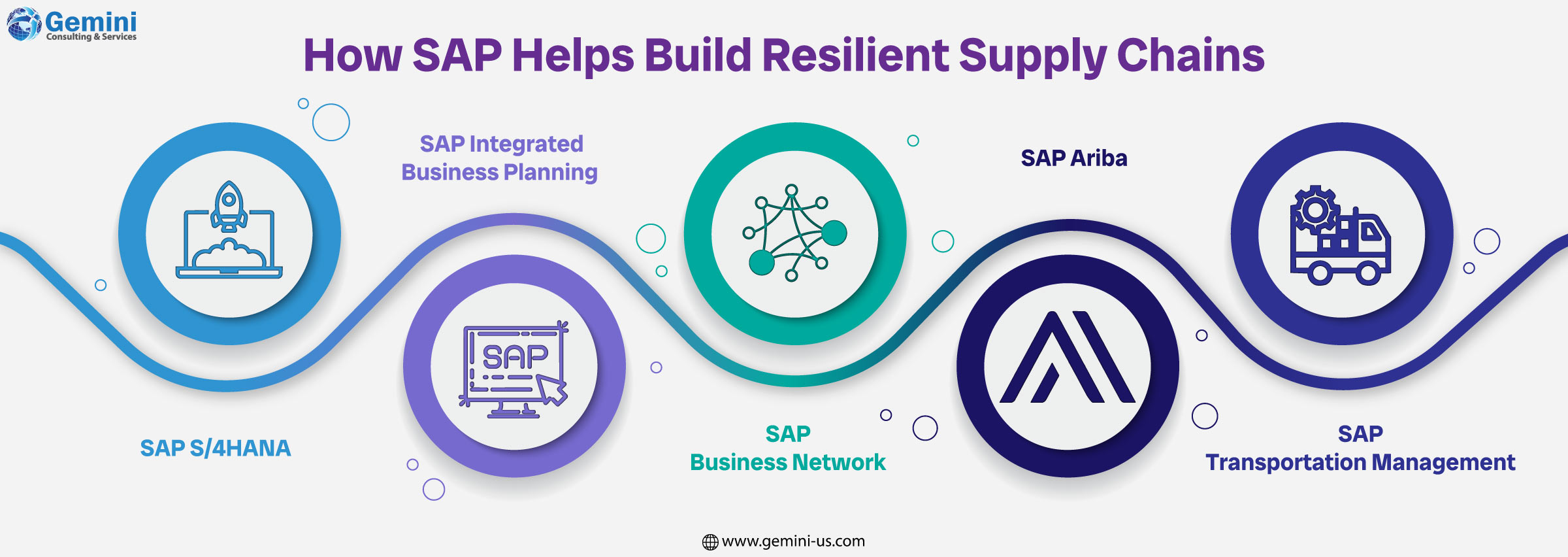
How SAP Helps Build Resilient Supply Chains
SAP offers a comprehensive suite of solutions designed to improve supply chain resilience through visibility, collaboration, and predictive intelligence.
SAP S/4HANA
SAP S/4HANA provides real-time data processing and analytics, enabling organizations to respond quickly to market changes and operational disruptions. Its intelligent capabilities support forecasting, inventory optimization, and automated decision-making.
SAP Integrated Business Planning (IBP)
SAP IBP enables organizations to integrate demand, supply, inventory, and financial planning into a unified process. It allows businesses to perform what-if analyses, compare different planning scenarios, and optimize inventory levels while remaining responsive to changing operational needs.
SAP Business Network
SAP Business Network connects suppliers, logistics providers, and business partners on a single platform. This collaborative ecosystem improves transparency, communication, and coordination across the entire supply chain.
SAP Ariba
SAP Ariba streamlines procurement processes while helping organizations manage supplier risk, compliance, and sourcing strategies. It also enables businesses to quickly identify alternative suppliers when disruptions occur.
SAP Transportation Management
SAP Transportation Management provides greater control over logistics operations through route optimization, shipment tracking, and freight management. These capabilities help organizations maintain efficient and reliable transportation networks even during volatile conditions.
Ready to streamline your supply chain with SAP solutions? Gemini Consulting & Services offers comprehensive implementation services designed to enhance operational efficiency and business performance. Contact us to discover how our SAP specialists can create a tailored solution aligned with your organization's unique objectives.
Conclusion
Supply chain resilience has become a business imperative in today's unpredictable environment. Organizations that invest in integrated planning, data-driven decision-making, supplier diversification, and advanced digital technologies are better equipped to navigate disruption and maintain operational continuity.
By leveraging SAP's powerful ecosystem of supply chain solutions, businesses can move beyond reactive crisis management and build agile, intelligent, and resilient supply chains that support long-term growth and competitive advantage.