
As artificial intelligence continues to reshape the workplace, businesses are moving beyond traditional automation toward a more intelligent and autonomous approach known as agentic automation. Unlike conventional automation tools that simply follow predefined rules, agentic automation enables AI-powered software agents to analyze information, make decisions, and complete complex tasks with minimal human intervention.
This new generation of automation is transforming how organizations manage operations, improve productivity, and respond to changing business needs.
What Is Agentic Automation?
Agentic automation combines advanced AI technologies such as large language models (LLMs), generative AI (GenAI), and other intelligent reasoning systems to create software agents capable of working independently.
Rather than relying on detailed, sequential instructions, AI agents can interpret objectives, process both structured and unstructured information, recognize patterns, determine appropriate actions, and carry out complex, multi-stage workflows. Their ability to respond to changing circumstances also makes them particularly valuable for business processes that involve uncertainty, dynamic conditions, or context-dependent decisions.
This marks a significant shift from traditional automation, which is primarily designed for repetitive, rule-based activities.
Why Agentic Automation Matters
Many business processes involve exceptions, changing inputs, or unstructured information such as emails, documents, and customer conversations. These tasks have historically required human involvement because conventional automation struggled to handle variability.
Agentic automation extends automation into these areas, allowing organizations to automate end-to-end workflows that were previously considered too complex. As a result, businesses can improve efficiency, reduce manual effort, and accelerate decision-making across multiple functions.
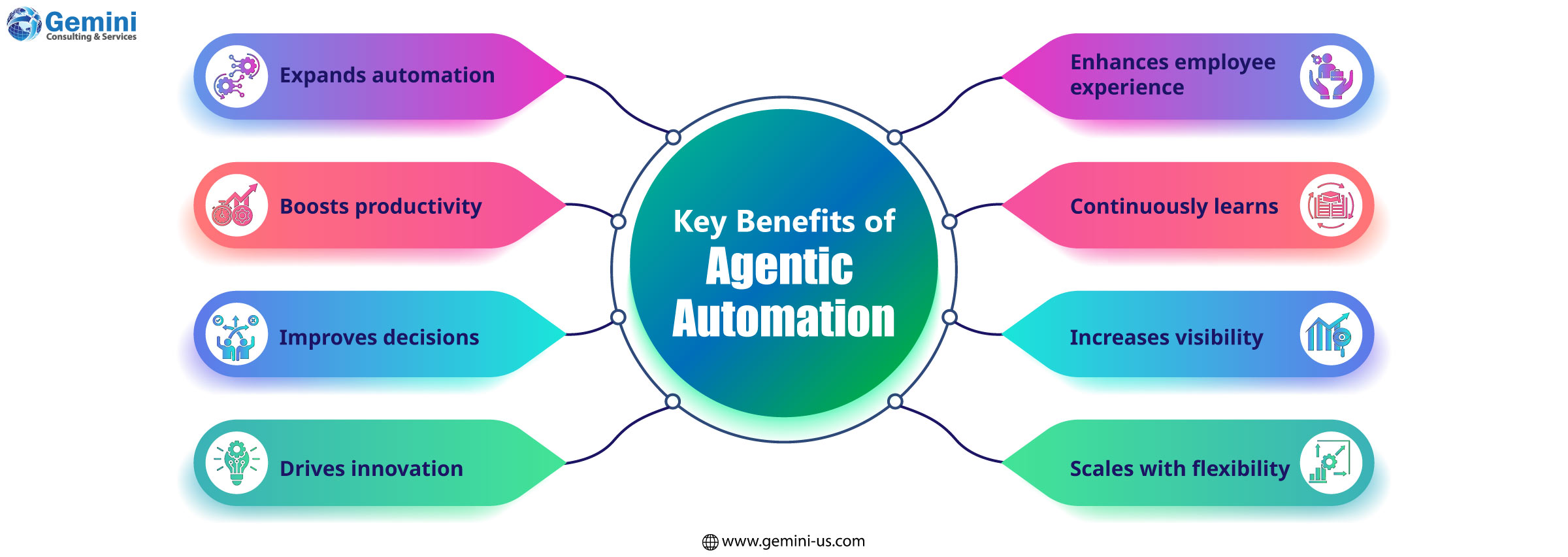
Expands Automation Across More Processes
Agentic automation enables businesses to automate complex workflows involving unstructured data, real-time analysis, and dynamic decision-making. This broadens the range of business activities that can benefit from automation.
Boosts Productivity and Efficiency
By taking over time-consuming tasks that require reasoning rather than simple rules, AI agents allow employees to focus on strategic, creative, and customer-facing responsibilities. Organizations benefit from faster processes with greater consistency and accuracy.
Improves Decision-Making
AI agents can process large volumes of data in real time, uncover trends, and recommend actions based on current information. This helps businesses make quicker, more informed decisions in areas such as supply chain management, fraud detection, and customer service.
Supports Innovation
By automating routine analysis and research, agentic automation frees employees to concentrate on innovation, problem-solving, and business growth. AI can also identify new market opportunities and suggest improvements based on data-driven insights.
Enhances Employee Experience
Rather than replacing people, agentic automation acts as a digital collaborator. Employees spend less time on repetitive work and more time applying their expertise, improving both engagement and job satisfaction. Agentic AI can take over repetitive and time-consuming activities, allowing employees to dedicate more attention to innovation, strategic planning, and complex decision-making. This not only improves productivity but can also increase job satisfaction by enabling people to work on more meaningful, high-value tasks. It promotes a more effective partnership between humans and AI, where each contributes according to their strengths.
AI agents can continuously monitor cloud infrastructure and optimize resource utilization across platforms such as AWS and Azure. By dynamically adjusting computing resources based on demand, they can help organizations avoid unnecessary capacity and reduce overall IT and cloud expenditure.
Learns and Improves Over Time
Advanced AI agents continuously monitor their own performance and refine their actions, enabling business processes to become more efficient as they gain experience.
Provides Better Visibility
Organizations gain deeper insights into workflow performance, automation effectiveness, and return on investment (ROI), helping leaders identify opportunities for further optimization.
Offers Scalability and Flexibility
Because AI agents can adapt to changing business conditions, organizations can scale operations more easily, respond faster to market shifts, and future-proof their automation strategy.
Agentic Automation vs. AI-Powered Automation vs. RPA
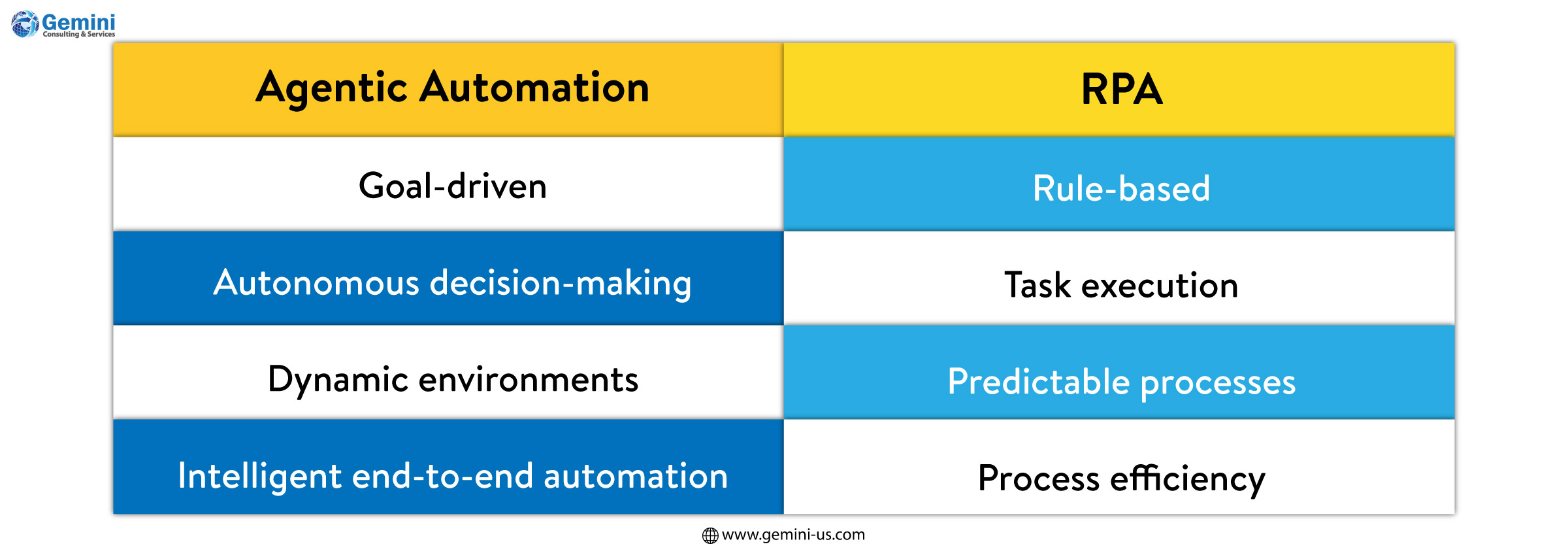
Although agentic automation represents a major advancement, it does not replace existing automation technologies. Instead, these approaches complement one another.
Robotic Process Automation (RPA) is ideal for repetitive, rules-based tasks such as invoice processing, data entry, and report generation. It delivers speed and accuracy when processes follow predictable rules.
AI-powered automation, often called intelligent automation, enhances RPA with capabilities such as document understanding, natural language processing, optical character recognition, and machine learning. While these systems can interpret more complex information, humans still define the workflow.
Agentic automation goes one step further by enabling AI agents to independently plan, coordinate, and execute work. Instead of following detailed instructions, agents determine how to achieve a business objective, making them suitable for dynamic and complex environments.
The future of enterprise automation will likely involve all three technologies working together, with each handling the tasks it performs best.
Agentic AI goes beyond conventional rule-based automation. Traditional automation typically relies on predefined scripts and fixed workflows, making it suitable mainly for predictable and repetitive tasks. When an unexpected situation occurs, these systems often require human intervention.
In contrast, agentic AI can interpret situations, make decisions, and take appropriate actions autonomously. For instance, during a customer service interaction, an AI agent can understand the customer's request, identify the appropriate solution, access relevant information, and initiate the required action, all within the same interaction.
Real-World Business Applications
Organizations across industries are already exploring agentic automation to improve operations.
Some common applications include:
- Customer service: Managing support requests, validating documents, and handling claims with minimal human intervention.
- Finance: Identifying unusual transactions, predicting cash-flow trends, automating invoice processing, and assessing financial risks.
- Sales and marketing: Optimizing campaigns, qualifying leads, and personalizing customer engagement.
- Supply chain: Monitoring inventory, coordinating procurement, and responding to disruptions in real time.
- IT operations: Automating service desk requests, incident management, and cybersecurity response.
As adoption grows, businesses are expected to discover many additional use cases that extend across departments and industries.
Governance Is Essential
While agentic automation offers significant advantages, organizations must implement strong governance to ensure AI agents operate safely and responsibly.
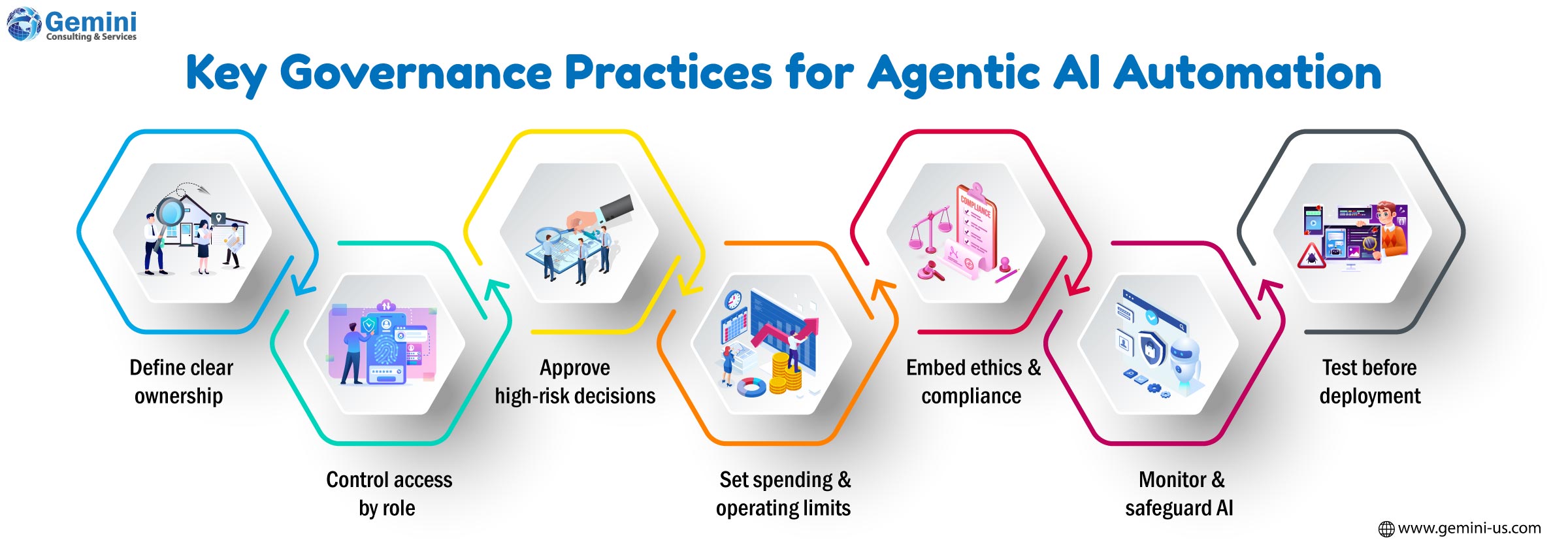
- Defining clear ownership and accountability for every AI agent.
- Limiting system access based on business roles.
- Establishing approval workflows for high-risk decisions.
- Setting spending limits and operational thresholds.
- Building ethical guidelines and compliance rules into AI systems.
- Including technical safeguards such as monitoring, validation, and emergency shutdown mechanisms.
- Regularly testing AI agents to identify potential risks before deployment.
Strong governance ensures organizations can capture the benefits of autonomous AI while maintaining security, compliance, and trust.
Gemini Consulting & Services can help your enterprise automate processes using agentic AI. Contact us to learn how our team of experts can provide you an efficient roadmap for agentic AI-based transformation.
Looking Ahead
By combining reasoning, planning, and autonomous execution, AI agents can automate increasingly sophisticated business processes that were previously beyond the reach of traditional technologies.
Rather than replacing RPA or intelligent automation, agentic automation complements them, creating a more flexible and intelligent automation ecosystem. Organizations that thoughtfully combine these technologies while implementing effective governance will be better positioned to improve efficiency, accelerate innovation, and remain competitive in an increasingly AI-driven business landscape.