Artificial Intelligence (AI) is rapidly transforming enterprise operations, enabling predictive forecasting, intelligent automation, real-time analytics, and faster decision-making. Businesses are investing heavily in advanced AI models, Large Language Models (LLMs), and intelligent enterprise applications to improve productivity and competitiveness.
However, an important question often gets overlooked: What happens when sophisticated AI models rely on inaccurate, fragmented, or poorly governed business data? The answer is straightforward. Even the most advanced AI technology cannot consistently deliver dependable business intelligence when its underlying data is unreliable.
For enterprises, the real competitive advantage lies not merely in selecting the most powerful AI model, but in building a trustworthy Enterprise Resource Planning (ERP) data foundation. AI may provide intelligence, but ERP data provides the business truth upon which that intelligence depends.
Why ERP Data Quality Outweighs AI Model Selection
ERP systems form the operational backbone of modern enterprises, integrating finance, procurement, inventory, manufacturing, sales, human resources, and supply chain management. These systems capture business transactions, enforce operational controls, and maintain essential records.
AI models, by contrast, identify patterns, generate predictions, recommend actions, and support decisions using available information.
This creates a fundamental distinction. ERP is the system of record and operational control, providing structured transactions, defined workflows, accountability, and auditability. AI is the system of intelligence, providing predictive insights, pattern recognition, intelligent recommendations, and workflow orchestration.
ERP processes are designed to produce consistent results under defined business rules, while generative AI and many machine learning applications introduce probabilistic reasoning. When ERP information is incomplete or inconsistent, even highly capable AI models can generate misleading recommendations.
Consider a manufacturing enterprise using AI to forecast raw material requirements. If inventory records contain duplicate items, inaccurate stock quantities, or delayed transaction updates, the forecasting model may recommend unnecessary purchases or underestimate critical requirements.
The primary challenge may not lie in the AI algorithm itself, but in the quality and reliability of the operational data on which it depends. Even advanced AI models cannot consistently deliver accurate and dependable results without a robust enterprise data foundation.
According to Mordor Intelligence, the global Enterprise Resource Planning market is estimated at $78.15 billion in 2026, increasing to $85.28 billion in 2027 and projected to reach &133.3 billion by 2032. The report estimates a compound annual growth rate (CAGR) of 9.35% between 2027 and 2032.
These projections highlight continued enterprise investment in integrated business platforms, standardized processes, operational visibility, and digital modernization.
As reported by Precedence Research, the global market for Artificial Intelligence (AI) in Enterprise Resource Planning (ERP) was estimated at USD 5.82 billion in 2025. The market is expected to expand from USD 7.33 billion in 2026 to approximately USD 58.7 billion by 2035, reflecting a projected compound annual growth rate (CAGR) of 26.00% over the forecast period from 2026 to 2035.
This growth reflects increasing interest in AI-powered financial analytics, predictive maintenance, demand forecasting, intelligent procurement, and automated enterprise workflows.
While market growth does not directly measure data quality, it reinforces the strategic importance of integrating intelligence with established enterprise systems.
Poor ERP Data and Business Risk
One of the biggest misconceptions about AI is that it can automatically overcome poor data quality. Although AI can identify inconsistencies and suggest corrections, it cannot independently guarantee that every business record represents reality.
Common ERP data problems include duplicate vendor records, inconsistent product classifications, inaccurate inventory balances, outdated financial information, incomplete customer profiles, and disconnected departmental databases.
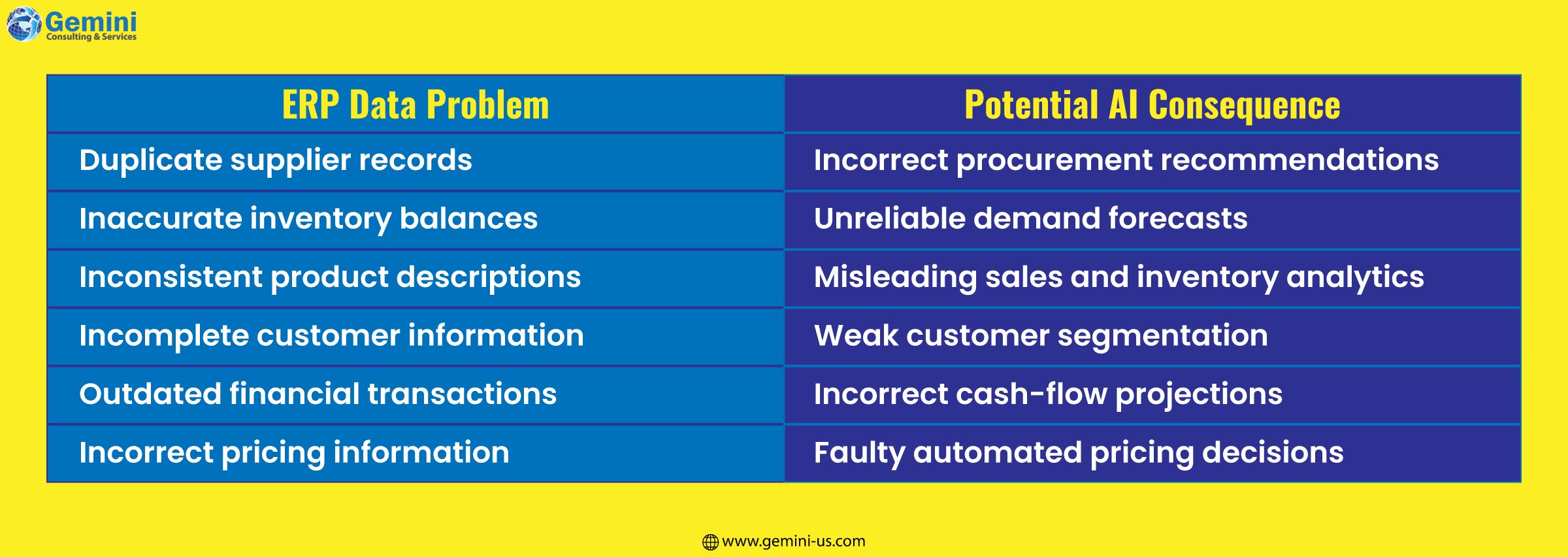
When AI moves beyond reporting into automated business execution, these risks become more serious. An incorrect recommendation might be reviewed and rejected by an employee. However, an AI-enabled procurement workflow operating without adequate controls could generate inappropriate purchase orders across multiple business units.
The greater the automation, the greater the need for reliable data, approval mechanisms, and human oversight.
The Importance of Data Governance
Successful enterprise AI requires more than accurate information. It needs clearly defined business rules, standardized processes, accountability, and traceable decisions.
ERP systems provide a structured environment through role-based access, transaction validation, approval hierarchies, segregation of duties, and audit trails. These controls help ensure that AI-driven actions remain within authorized business boundaries.
Organizations must treat ERP data governance as a strategic business responsibility rather than merely an IT maintenance activity. Without effective governance, AI can accelerate mistakes just as efficiently as it accelerates productivity.
Competitive Advantage of Standardized ERP Data
As enterprises expand across geographies, business units, currencies, and regulatory environments, maintaining consistent information becomes increasingly complex. Different departments may interpret the same business metric differently. Finance, sales, and operations might calculate profitability using separate assumptions, creating conflicting reports.
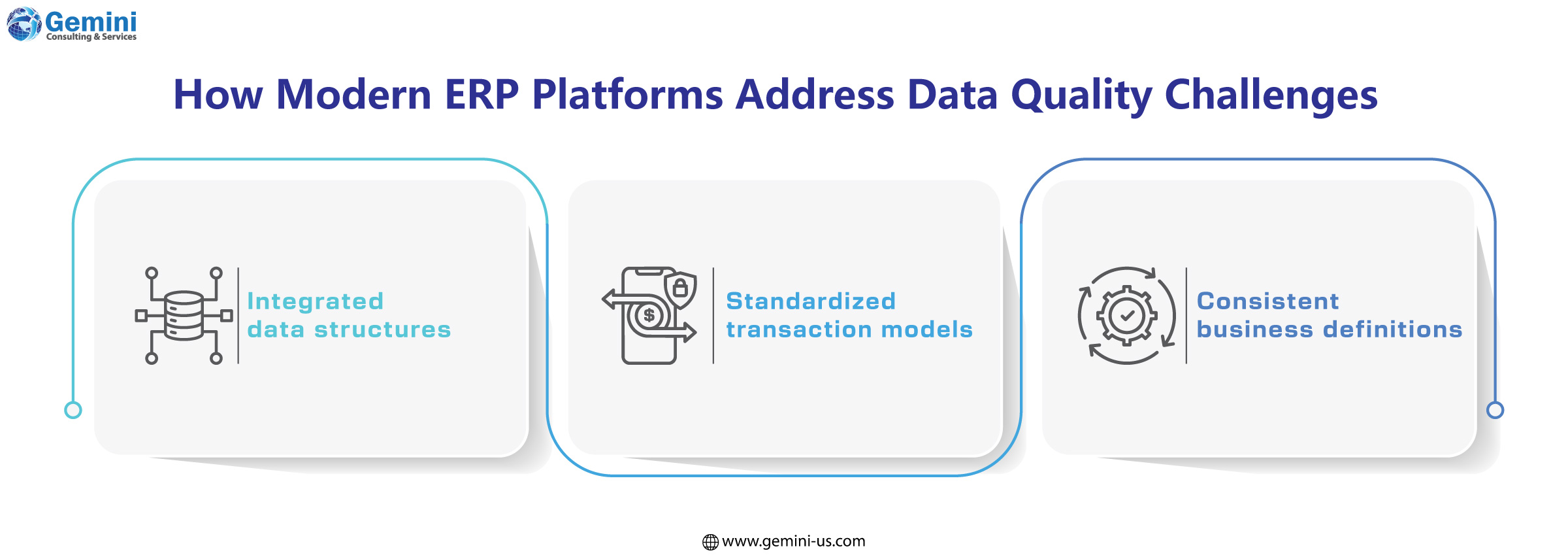
Modern ERP platforms help address these challenges through integrated data structures, standardized transaction models, and common business definitions. Leading enterprise technology providers such as SAP, Oracle, and Workday are incorporating AI capabilities into their ERP environments, including intelligent invoice processing, financial anomaly detection, predictive analytics, and automated workflow assistance. This approach combines established operational controls with advanced intelligence.
By contrast, organizations developing entirely customized enterprise platforms may face substantial long-term costs involving maintenance, cybersecurity, regulatory changes, technical debt, and specialist staffing.
The strategic opportunity is therefore not to rebuild every existing enterprise capability around AI, but to strengthen the ERP foundation and apply AI where it delivers measurable business value.
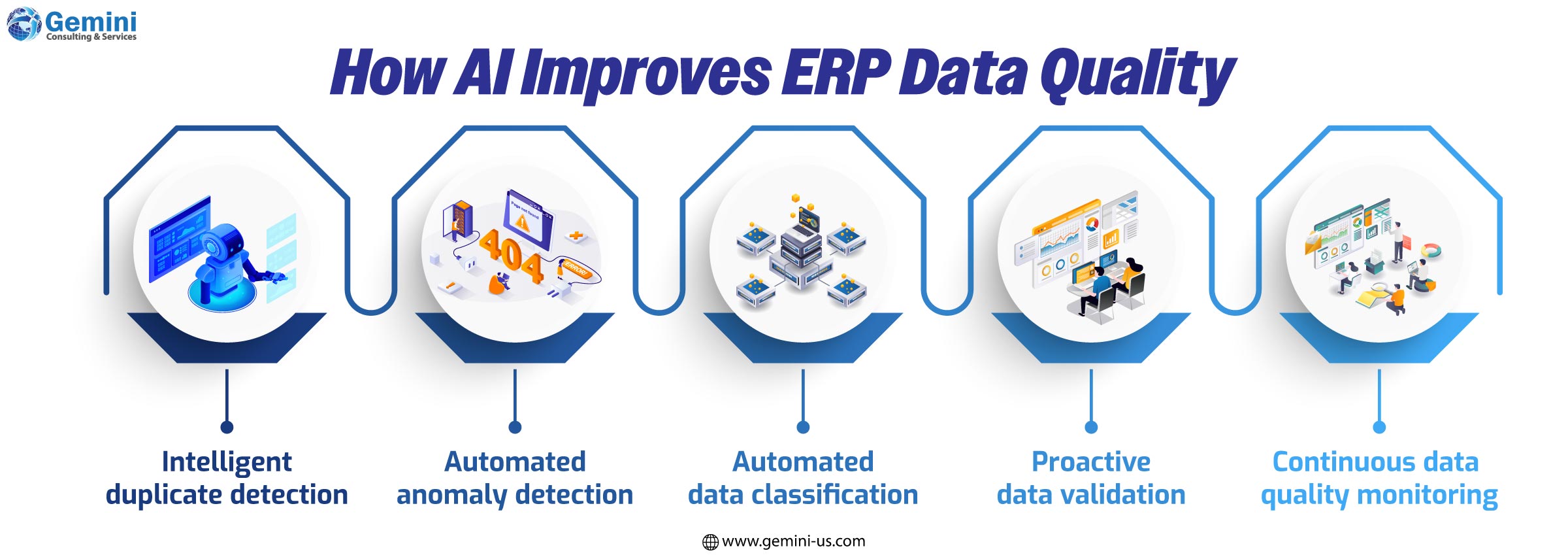
Interestingly, AI is not merely a consumer of ERP data. It can also become an important tool for improving that data.
Machine learning and natural language processing can support:
- Intelligent duplicate detection: Identifying similar customer, supplier, or material records despite spelling differences.
- Anomaly identification: Flagging unusual transaction amounts, inconsistent classifications, and unexpected inventory movements.
- Automated classification: Recommending standardized categories for products, vendors, and financial transactions.
- Preventive data validation: Detecting potential errors before they enter operational workflows.
- Continuous data monitoring: Highlighting emerging quality issues across departments and systems.
However, AI-generated corrections should remain explainable, auditable, and subject to appropriate validation. The objective is to use AI to strengthen enterprise data integrity, not introduce another layer of uncontrolled automation.
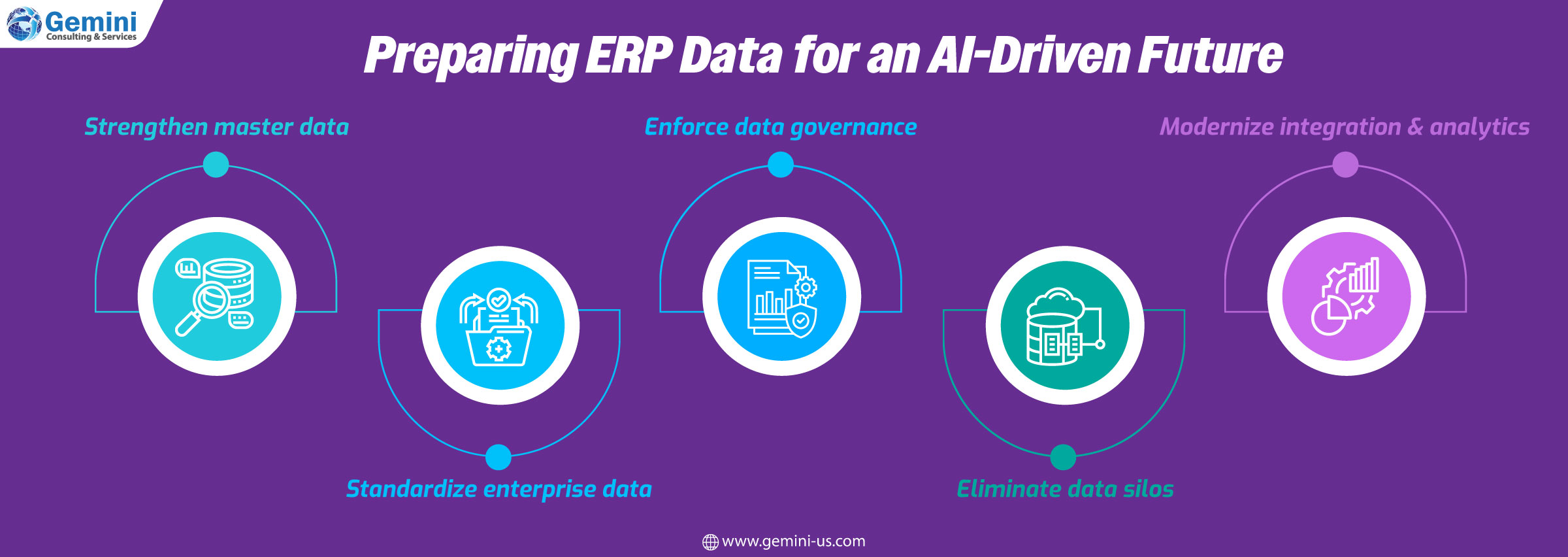
Organizations do not need flawless ERP data before beginning their AI journey. They do, however, need a structured approach to improving data readiness. Five priorities deserve immediate attention.
First, strengthen master data management. Review customer, supplier, product, inventory, pricing, and financial master records to eliminate duplication and inconsistencies.
Second, establish enterprise-wide data standards. Ensure that business units follow common naming conventions, classifications, accounting structures, and reporting definitions.
Third, enforce data governance at the source. Implement validation rules, mandatory fields, approval workflows, and clearly assigned data ownership.
Fourth, reduce fragmented information systems. Minimize unnecessary spreadsheet-based processes and disconnected departmental databases that undermine ERP integrity.
Fifth, modernize ERP integration and analytics. Improve data synchronization, monitoring, security, and interoperability before scaling AI-driven automation.
Equally important is employee training. Reliable ERP data depends on disciplined business processes and accountable users, not technology alone.
From Systems of Record to Systems of Business Outcomes
The future enterprise will increasingly combine ERP's transactional reliability with AI's analytical intelligence. ERP will continue to manage transactions, business rules, financial controls, and operational accountability. AI will help enterprises anticipate demand, identify emerging risks, optimize resources, automate routine activities, and support better decisions.
Together, they can transform traditional reporting into proactive, intelligence-driven operations. But this transformation requires a fundamental shift in investment priorities.
As a trusted technology partner to leading global enterprises, Gemini Consulting & Services empowers organizations to strengthen ERP data governance and seamlessly incorporate AI-driven capabilities. Connect with our experts to discover how our tailored solutions can help optimize your business operations and accelerate digital transformation.
The Best AI Strategy Starts with Trusted ERP Data
AI models will continue to evolve, becoming faster, more capable, and increasingly accessible. However, the importance of reliable enterprise data will not diminish. Organizations that invest in ERP data quality, process standardization, governance, and operational modernization will be better positioned to realize sustainable returns from AI. The real differentiator will not always be who deploys the most advanced AI model, but who enables AI to operate on the most dependable business information.
ERP provides the foundation. Data provides the truth. AI provides the intelligence. Together, they deliver meaningful business outcomes. In the age of intelligent enterprises, the quality of your ERP data may matter more than the sophistication of your AI model.