In an increasingly dynamic consumer goods market, supply chains must do more than move products from manufacturers to retailers. They must anticipate consumer needs, respond rapidly to market changes, and ensure that the right products are available at the right place and time. An AI-powered connected supply chain enables this shift by bringing together people, processes, systems, and data across the entire value chain.
A connected supply chain integrates suppliers, manufacturers, distributors, retailers, and internal business functions into a unified digital ecosystem. By combining Artificial Intelligence (AI), the Internet of Things (IoT), cloud platforms, predictive analytics, and automation, companies can gain end-to-end visibility and make faster, better-informed decisions.
For consumer goods companies operating across diverse markets, channels, and customer segments, this connectivity creates an opportunity to move from reactive operations to predictive and increasingly adaptive supply chain management.
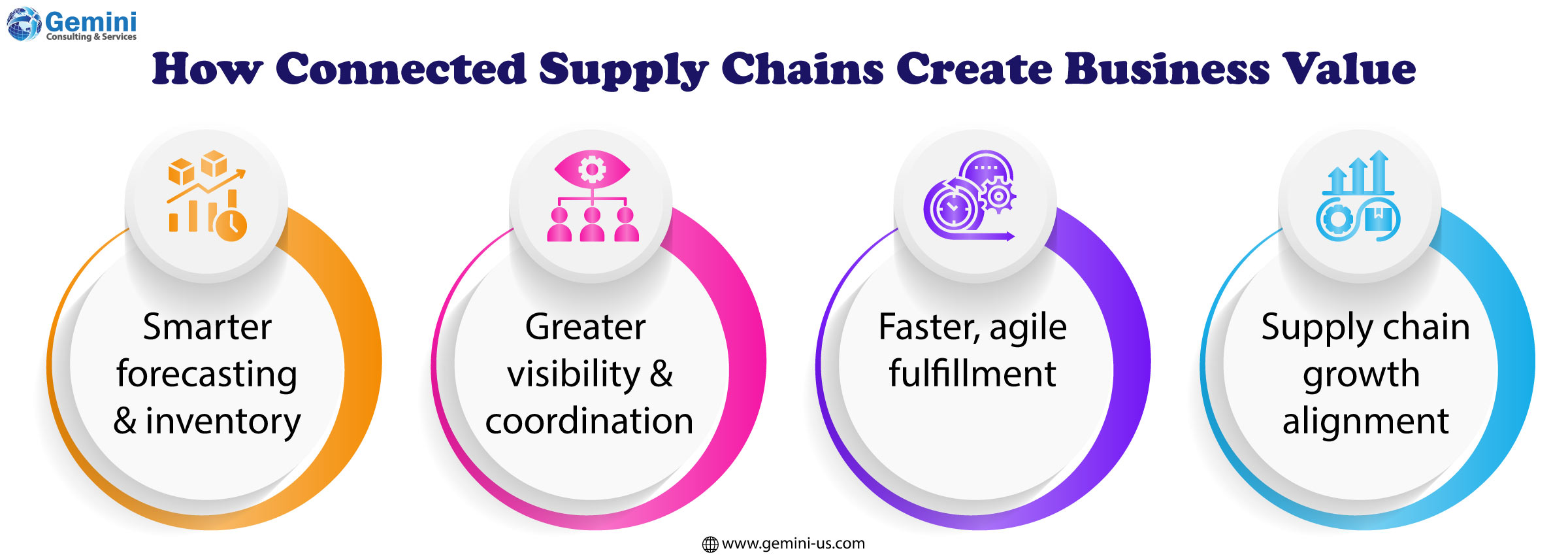
The value of a connected supply chain extends beyond operational efficiency. It enables closer collaboration, improves responsiveness, and aligns supply chain decisions with commercial priorities.
1. Improved demand forecasting and inventory optimization
AI-powered analytics combine historical sales, inventory levels, promotions, market trends, and external signals to generate more accurate demand forecasts. Generative AI can further enrich these insights by analyzing unstructured information, including online search trends, social media conversations, and consumer feedback.
These capabilities help companies anticipate emerging product preferences, reduce excess inventory, minimize stockouts, and optimize working capital. They can also identify regional demand variations and adjust replenishment plans accordingly.
2. Greater operational visibility and coordination
Connected systems provide a shared view of inventory, production, shipments, and customer demand. IoT sensors, RFID technologies, and GPS-enabled tracking improve visibility into goods as they move across the supply chain.
When disruptions occur, AI can help assess their potential impact and recommend alternative sourcing, production, or distribution strategies. This enables teams to respond proactively rather than relying on delayed reports or fragmented information.
3. Faster, more responsive fulfillment
By connecting demand planning, manufacturing, warehousing, transportation, and retail operations, companies can coordinate decisions across the value chain. AI-driven recommendations can help prioritize orders, optimize delivery routes, allocate constrained inventory, and improve replenishment.
The result is a more responsive operating model that can improve service levels, shorten lead times, and support product availability across traditional and digital retail channels.
4. Stronger alignment between supply chain and commercial growth
Supply chain decisions have a major impact on how consumers discover and buy products. When products are unavailable on digital platforms or in physical stores, companies risk losing sales or having consumers switch to competing brands.
A connected supply chain allows commercial and operational teams to jointly evaluate demand opportunities, product availability, promotional plans, and fulfillment capacity. This helps businesses align growth ambitions with their ability to deliver, making supply chain a strategic contributor to revenue rather than simply a function responsible for execution.
The Role of AI and Generative AI
AI transforms connected supply chains by converting large volumes of data into actionable insights. Predictive models support demand forecasting, inventory planning, logistics optimization, and early identification of potential disruptions.
Generative AI extends these capabilities by interpreting complex information, summarizing insights, and enabling users to interact with supply chain data through conversational interfaces. It can bring together structured enterprise information and unstructured external signals to identify emerging opportunities and recommend potential actions.
For example, a sudden increase in online conversations about a product may indicate a developing consumer trend. AI can help validate this signal against sales data, inventory availability, production capacity, and regional demand. Supply chain and commercial teams can then coordinate production, replenishment, and distribution decisions to respond more quickly.
AI-enabled decision support can also provide frontline employees with contextual recommendations, helping store teams, planners, and logistics personnel resolve issues with less manual analysis. Over time, more mature systems may automate selected decisions within defined business rules and human oversight.
What the EY Study Reveals
According to the EY’s State of Consumer Products research, conducted in collaboration with Oxford Economics, more than 850 senior executives across 24 markets were surveyed. The findings highlight the opportunity for consumer products companies to translate investments in technology and improved visibility into faster, coordinated action.
The study reports that 94% of consumer products supply chain executives say they are transforming the function. The next priority is to embed this transformation into everyday operations so organizations can respond more effectively to fragmented demand and changing growth opportunities.
The research also underscores the growing relationship between commercial strategy and supply chain execution. As AI agents, retailer algorithms, and digital platforms increasingly influence product discovery, availability and fulfillment reliability can directly affect what consumers see, what platforms recommend, and what they ultimately purchase.
This makes supply chain involvement in growth decisions essential. Companies need to evaluate operational readiness, product availability, and fulfillment capabilities when deciding which markets, channels, and consumer opportunities to prioritize.
Building the Foundations for AI-Enabled Connectivity
Despite its potential, implementing an AI-powered connected supply chain requires more than deploying new technology. Many organizations operate with disconnected enterprise applications, legacy systems, inconsistent data, and fragmented planning processes.
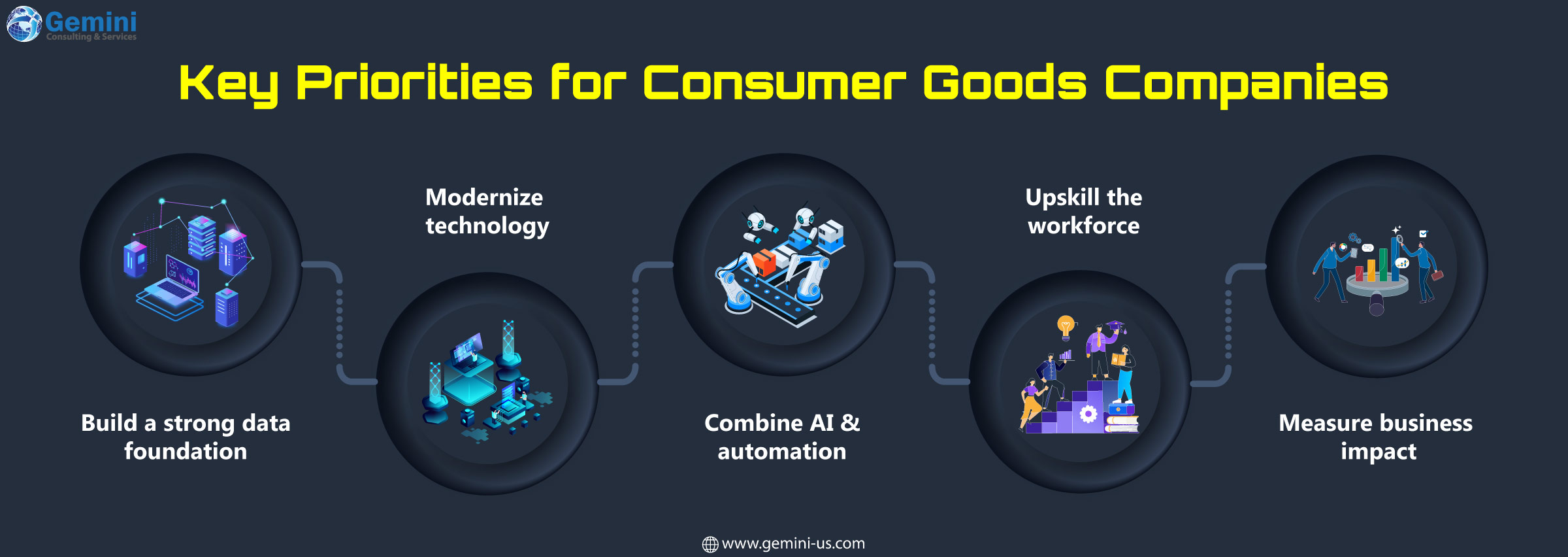
- Establish a robust data foundation: Integrate internal and external data, improve data quality, and establish clear ownership, security, and governance standards.
- Modernize technology architecture: Use scalable cloud platforms and interoperable applications to connect planning, procurement, manufacturing, logistics, sales, and retail systems.
- Integrate AI with existing automation: Combine predictive analytics, generative AI, and traditional process automation to improve both routine execution and complex decision-making.
- Invest in workforce capabilities: Equip employees to interpret AI-generated insights, validate recommendations, and collaborate effectively with intelligent systems.
- Demonstrate measurable business value: Start with targeted use cases, such as forecast accuracy, inventory optimization, order fulfillment, or product availability, and scale successful initiatives based on demonstrated outcomes.
Responsible AI adoption also requires attention to explainability, data privacy, cybersecurity, and human oversight. These safeguards help ensure that AI-driven decisions remain reliable, accountable, and aligned with business objectives.
Looking to transform your supply chain with AI-driven solutions? Gemini Consulting & Services can use the latest AI technologies to turn data into insights for consumer goods companies. These insights can in turn streamline supply chain processes to boost efficiency and overall performance. Get in touch with us to discover how AI-driven solutions can strengthen supply chain operations and deliver measurable business value.
The Future: A More Agile and Consumer-Centric Value Chain
The next generation of connected supply chains will increasingly combine real-time data, predictive intelligence, and coordinated decision-making across the enterprise. Digital twins can help companies simulate alternative scenarios, while AI-enabled planning tools can refresh operational plans as demand, supply, or capacity changes.
This flexibility allows consumer goods companies to tailor supply chain strategies to different regions, customer segments, and sales channels. Businesses can efficiently replenish high-demand products while adapting quickly to changing market trends and niche customer needs.
Ultimately, an AI-powered connected supply chain is not simply a technology initiative or a cost-reduction exercise. It is a strategic transformation that connects operational execution with consumer needs and commercial growth.
Companies that combine trusted data, integrated digital platforms, intelligent automation, and empowered employees will be better positioned to improve product availability, strengthen resilience, optimize working capital, and capture emerging market opportunities. By making the supply chain more connected, predictive, and responsive, consumer goods businesses can build a lasting competitive advantage in a rapidly evolving marketplace.