Over the past few years, businesses have embraced AI-powered chatbots and virtual assistants to improve customer interactions, retrieve information, and support employees. These technologies have made information more accessible, but a critical challenge remains, much of the actual work still depends on human intervention. Employees continue to switch between applications, process documents, update records, coordinate approvals, and manually complete tasks across disconnected enterprise systems.
This is where AI agents are changing the enterprise automation landscape. Unlike conventional chatbots that primarily respond to questions, AI agents can interpret objectives, plan actions, interact with enterprise applications, and execute multi-step workflows within predefined business rules.
The growing AI Agents Market
According to Grand View research, the global enterprise artificial intelligence market was valued at $23.9 billion in 2024 and is projected to grow from $42 billion in 2026 to $155.2 billion by 2030, with a CAGR of 37.6% from 2025 to 2030. North America accounted for 36.9% of market revenue in 2024.
Similarly, MarketsandMarkets projects that the AI agents’ market will expand from $7.84 billion in 2025 to $52.62 billion by 2030, registering a CAGR of 46.3%.
These projections highlight increasing enterprise investment in intelligent automation and AI-driven operational efficiency.
Why Traditional Chatbots Fall Short in Enterprise Workflows
Chatbots have become valuable tools for answering customer queries, explaining policies, and retrieving information. However, most traditional chatbot implementations focus on communication rather than completing business transactions. While a chatbot explains the process, an AI agent can execute it.
Modern chatbots equipped with tools can also perform actions, so the distinction is not simply the conversational interface. It lies in the system's ability to coordinate, execute, and track workflows across multiple applications.
Most organizations already operate ERP, CRM, HRMS, document management, and collaboration platforms. Yet these applications frequently function in silos, forcing employees to act as intermediaries.
AI agents help bridge these gaps by introducing an intelligent orchestration layer across enterprise systems.
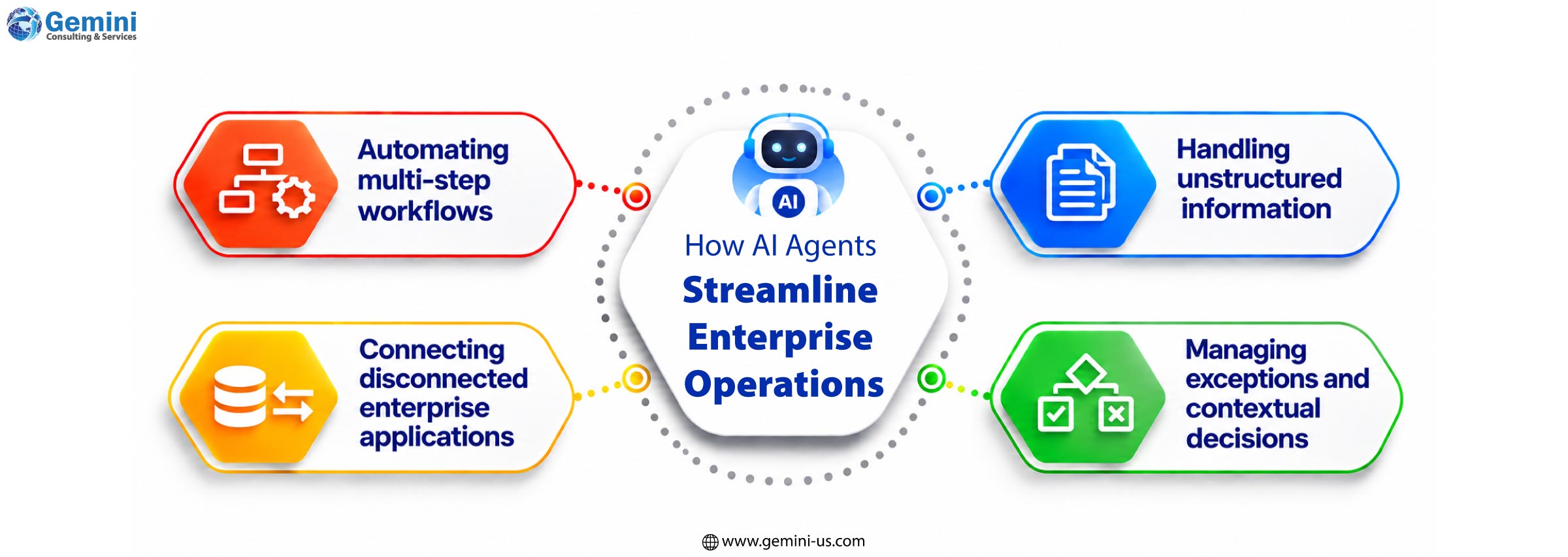
1. Automating Multi-Step Workflows
Enterprise processes rarely involve a single action. Invoice processing, for example, requires document extraction, vendor verification, purchase order matching, approvals, and accounting updates. An AI agent can coordinate these activities across integrated systems, identify discrepancies, and escalate exceptions when necessary. This reduces repetitive work while helping teams to complete transactions more efficiently.
2. Connecting Disconnected Enterprise Applications
AI agents interact with business applications through APIs, authorized tools, and integration services. For instance, an employee onboarding agent can coordinate activities across HR, IT, and administration systems to initiate account provisioning, request equipment, assign training, and monitor completion. Instead of manually coordinating departments, HR teams can manage the process through a unified workflow.
3. Handling Unstructured Information
Traditional automation works best with predictable inputs and fixed rules. However, business operations frequently involve emails, invoices, contracts, and documents with inconsistent formats. AI agents can interpret this information, extract relevant details, validate them against enterprise records, and initiate appropriate actions. This makes agent-based automation particularly useful for document-intensive business processes.
4. Managing Exceptions and Contextual Decisions
Real-world workflows rarely follow identical paths. An invoice may contain missing information, a customer request may require additional verification, or a procurement transaction may exceed an approval threshold. AI agents can evaluate the available context, apply configured policies, and determine whether to proceed, request clarification, or escalate the issue. This adaptability helps enterprises manage operational variability without relying entirely on rigid automation scripts.
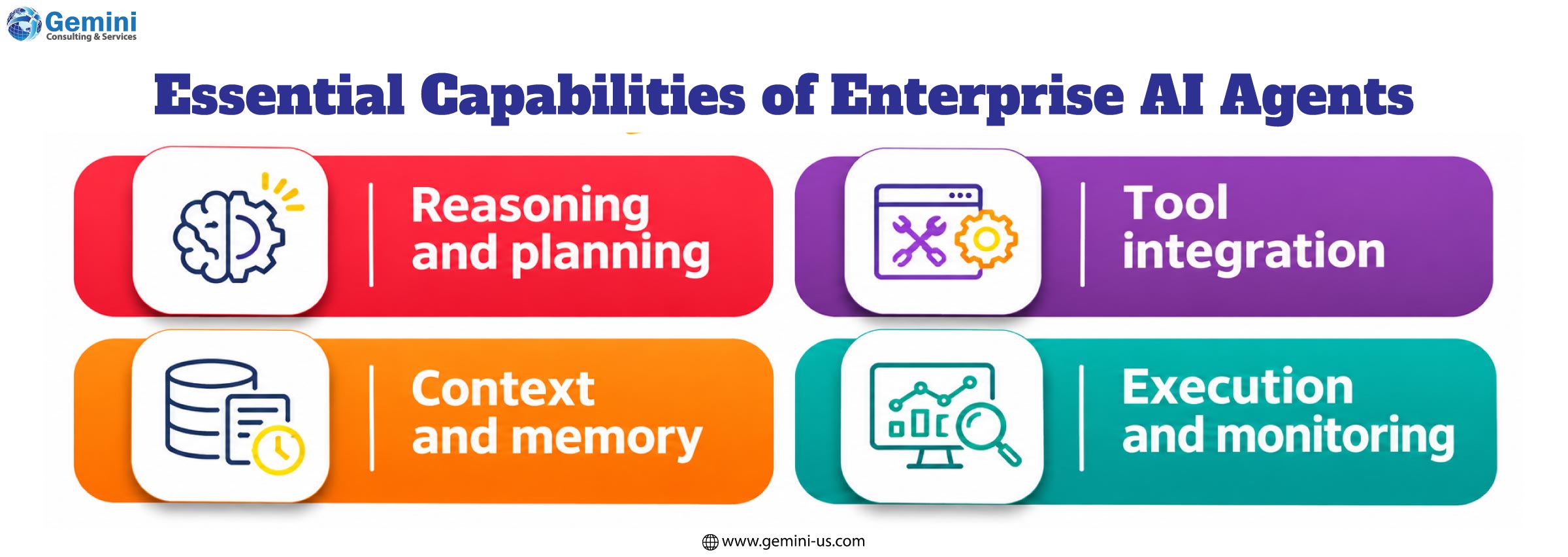
Enterprise AI agents combine several capabilities to move from understanding requests to completing tasks.
Reasoning and Planning: Agents interpret business objectives, evaluate available information, and divide complex processes into manageable actions.
Tool Integration: Secure APIs and predefined functions allow agents to retrieve records, update applications, and initiate authorized transactions.
Context and Memory: Workflow state management enables agents to track previous actions, maintain continuity, and resume processes that span multiple interactions.
Execution and Monitoring: Agents perform approved actions, monitor outcomes, and identify situations requiring human intervention.
Together, these capabilities support an operational cycle of understanding a task, planning its execution, performing actions, validating results, and progressing towards completion. For enterprise deployment, these functions must be supported by reliable integrations, access controls, and audit mechanisms.
Enterprise Use Cases for AI Agents
AI agents offer significant opportunities in departments where repetitive activities involve multiple applications, business rules, and approvals.
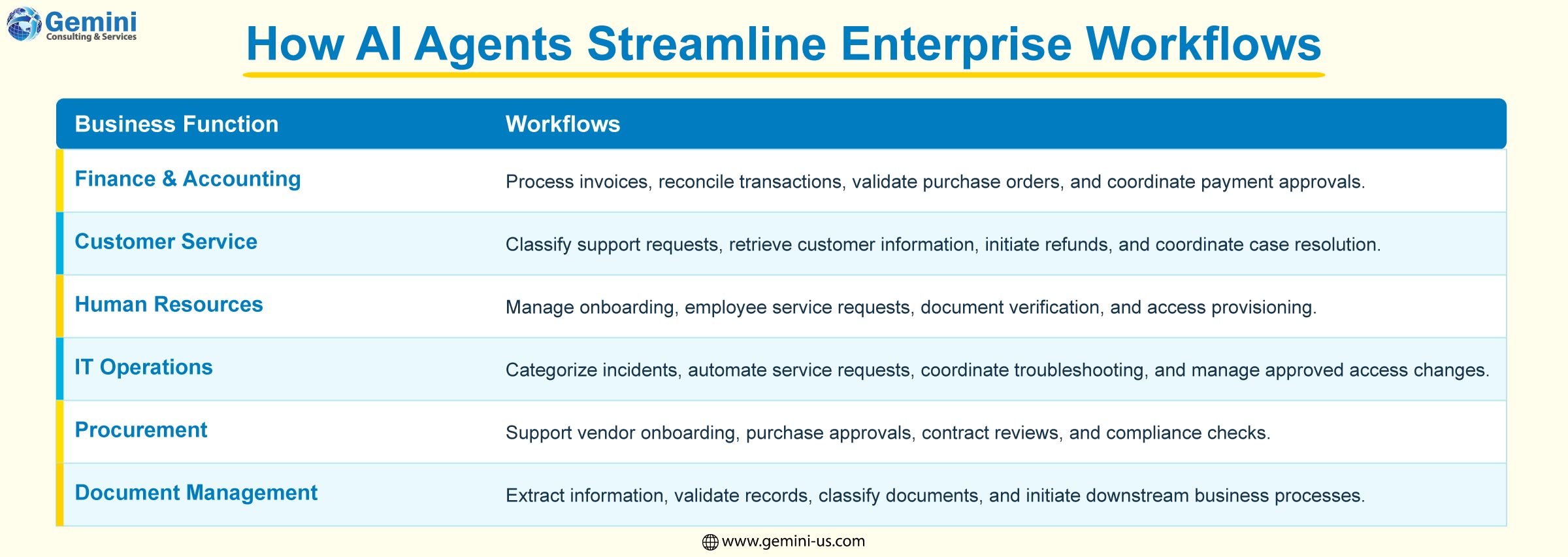
The common advantage across these applications is reduced manual coordination between systems, allowing employees to focus on exceptions, decisions, and higher-value activities.
AI Agents vs. Traditional RPA: A Complementary Approach
For years, Robotic Process Automation (RPA) has enabled businesses to streamline operations by automating repetitive tasks governed by predefined rules. However, traditional RPA solutions are most effective in environments with structured data and consistent workflows. Any changes to document layouts, software interfaces, or business requirements may disrupt automation and require ongoing adjustments and maintenance.
AI agents introduce greater flexibility by interpreting context, handling varied inputs, and determining appropriate workflow actions. This does not mean enterprises need to replace existing RPA investments. A more effective strategy is to combine both technologies.
RPA can execute stable, repetitive activities, while AI agents coordinate complex workflows, interpret unstructured information, and manage decision points. Together, they enable a more adaptable enterprise automation environment.
Building Secure and Governed AI Agent Platforms
Although AI agents can execute business operations with greater autonomy, enterprise adoption requires careful attention to security, accountability, and compliance.
Organizations should establish:
- Role-based access controls: Restrict agents to authorized systems, information, and actions.
- Human-in-the-loop approvals: Require employee authorization for sensitive financial, contractual, or operational decisions.
- Data governance: Protect confidential information and enforce enterprise data policies.
- Audit trails: Record agent decisions, system interactions, and transaction outcomes.
- Execution safeguards: Use validated APIs, transaction limits, exception handling, and monitoring to prevent unauthorized or incorrect actions.
These safeguards allow enterprises to introduce automation without compromising operational control.
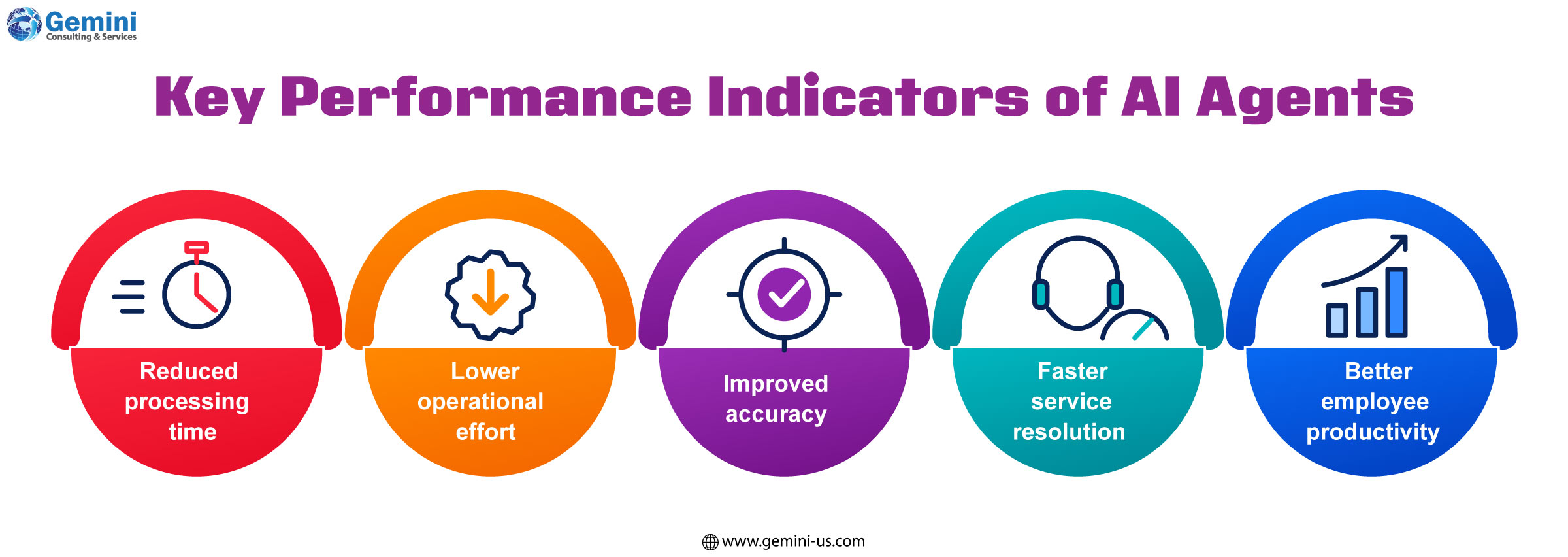
Reduced Processing Time: Faster execution of workflows through fewer manual handoffs and delays.
Lower Operational Effort: Less repetitive data entry, document handling, and application switching.
Improved Accuracy: Consistent validation against enterprise records and business rules, with fewer manual transcription errors.
Faster Service Resolution: More efficient handling of customer requests, IT incidents, and internal service tickets.
Better Employee Productivity: More time available for analytical, strategic, and customer-focused responsibilities.
The greatest potential value often comes from workflows involving multiple systems, frequent exceptions, and significant manual coordination.
How Enterprises Can Get Started with AI Agents
Successful implementation requires a structured approach rather than attempting enterprise-wide automation immediately.
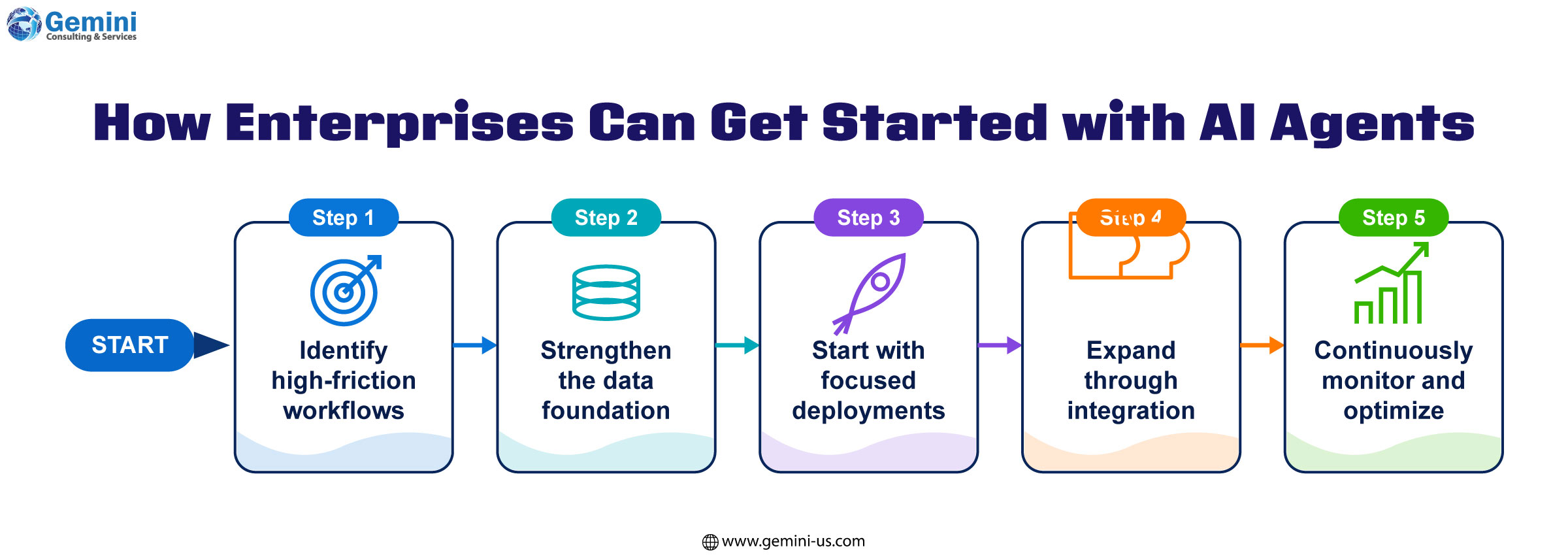
Step 1: Identify high-friction workflows. Prioritize repetitive processes with measurable operational costs and frequent system handoffs.
Step 2: Strengthen the data foundation. Organize enterprise knowledge, business rules, standard operating procedures, and application access.
Step 3: Start with focused deployments. Implement an agent for a clearly defined workflow, establish human oversight, and validate performance.
Step 4: Expand through integration. Connect additional applications and business processes after demonstrating reliability and measurable value.
Step 5: Continuously monitor and optimize. Track execution quality, exceptions, security, and business outcomes.
This phased strategy helps organizations reduce implementation risks while developing scalable automation capabilities.
At Gemini Consulting & Services, we help organizations transition from conversational AI solutions to intelligent, execution-driven enterprise automation. We focus on developing AI agent platforms that connect existing business systems, streamline operational workflows, and deliver measurable improvements in efficiency and productivity. Whether your organization is exploring its first AI agent or scaling automation across departments, contact us to build a secure and scalable foundation.
Conclusion: The Future of Enterprise AI Is Action-Oriented
The next stage of enterprise AI transformation is not simply about generating better answers. It is about completing business processes more efficiently. While chatbots improve how employees and customers access information, AI agents extend AI capabilities into workflow execution, cross-system coordination, and intelligent process automation.
By combining reasoning, planning, enterprise integration, and governance, organizations can reduce manual dependencies and create more connected, responsive operations. The real opportunity is to move beyond AI that tells employees what to do, towards AI that helps get the work done.