
The modern business environment is characterized by constant change, making organizational agility a critical factor for sustained success. Evolving customer demands, economic fluctuations, disruptions in global supply chains, and continuous technological innovation require organizations to respond promptly while maintaining high levels of operational performance. In this context, technology serves as a key driver of business agility, enabling organizations to innovate, adapt to changing market conditions, and strengthen their resilience for long-term growth.
However, technology alone does not create an agile business. Its true value is realized when combined with a culture that embraces continuous learning, collaboration, and adaptability.
Technology: The Foundation of Business Agility
Modern technology enables businesses to streamline operations, improve decision-making, and respond to changing market conditions with speed and confidence. Rather than relying on disconnected systems and manual processes, organizations can leverage integrated digital platforms that improve visibility, efficiency, and collaboration across the enterprise.
The result is faster execution, better customer experiences, and the ability to pivot when new opportunities or challenges arise.
According to Grand View Research, the global digital transformation market was estimated at $1,302.9 billion in 2025. It is expected to increase to $1,583.2 billion in 2026 and reach approximately $5,493.1 billion by 2033, reflecting a compound annual growth rate (CAGR) of 19.4% over the forecast period from 2026 to 2033.
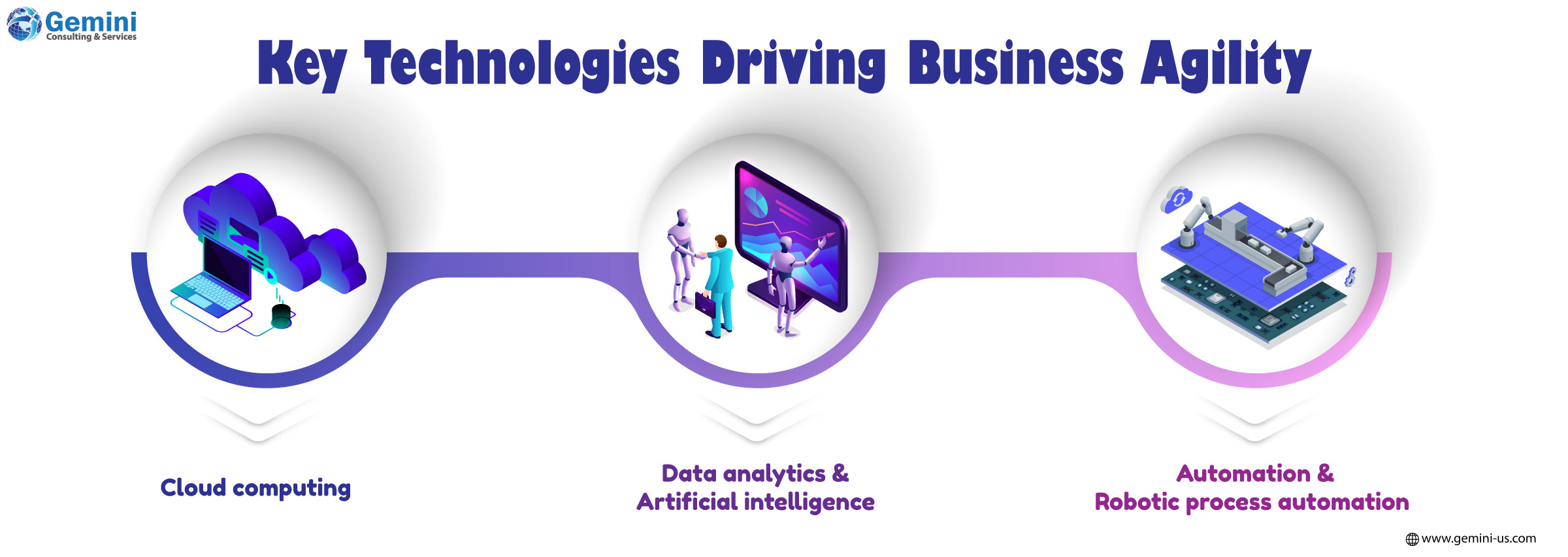
Cloud Computing
The emergence of cloud computing has significantly reshaped how businesses deploy, access, and maintain technological infrastructure. Instead of investing heavily in physical infrastructure, organizations can scale computing resources on demand, deploy applications quickly, and enable secure access from virtually anywhere.
Cloud-based solutions also support remote and hybrid work environments, ensuring employees remain productive regardless of location while allowing businesses to expand without significant infrastructure investments.
Data Analytics and Artificial Intelligence
With data being increasingly used for gaining business insights, advanced analytics, artificial intelligence (AI), and machine learning tools have become essential for organizations to convert large volumes of data into actionable insights.
These technologies enable businesses to monitor customer behavior, forecast demand, identify operational bottlenecks, and make informed decisions faster. Predictive analytics also allows organizations to anticipate market trends rather than simply reacting to them.
Automation and Robotic Process Automation (RPA)
Automation reduces repetitive manual work by streamlining routine business processes such as data entry, invoice processing, inventory updates, and reporting.
By automating these tasks, organizations reduce operational costs, minimize human error, and free employees to focus on innovation, strategic planning, and customer engagement. Automation also improves consistency and speeds up workflows across departments.
Collaboration and Communication Tools
Business agility depends on effective communication. Modern collaboration platforms enable teams to work together in real time through instant messaging, video conferencing, shared documents, and integrated project management.
These tools eliminate communication barriers, accelerate decision-making, and improve coordination among employees, partners, and customers—even when teams are geographically dispersed.
Agile Software Development
Organizations that develop digital products increasingly rely on Agile development practices supported by Continuous Integration and Continuous Delivery (CI/CD) tools. These approaches enable development teams to release new features, resolve issues quickly, and continuously improve products based on customer feedback.
This faster innovation cycle allows businesses to remain competitive while responding rapidly to changing customer needs.
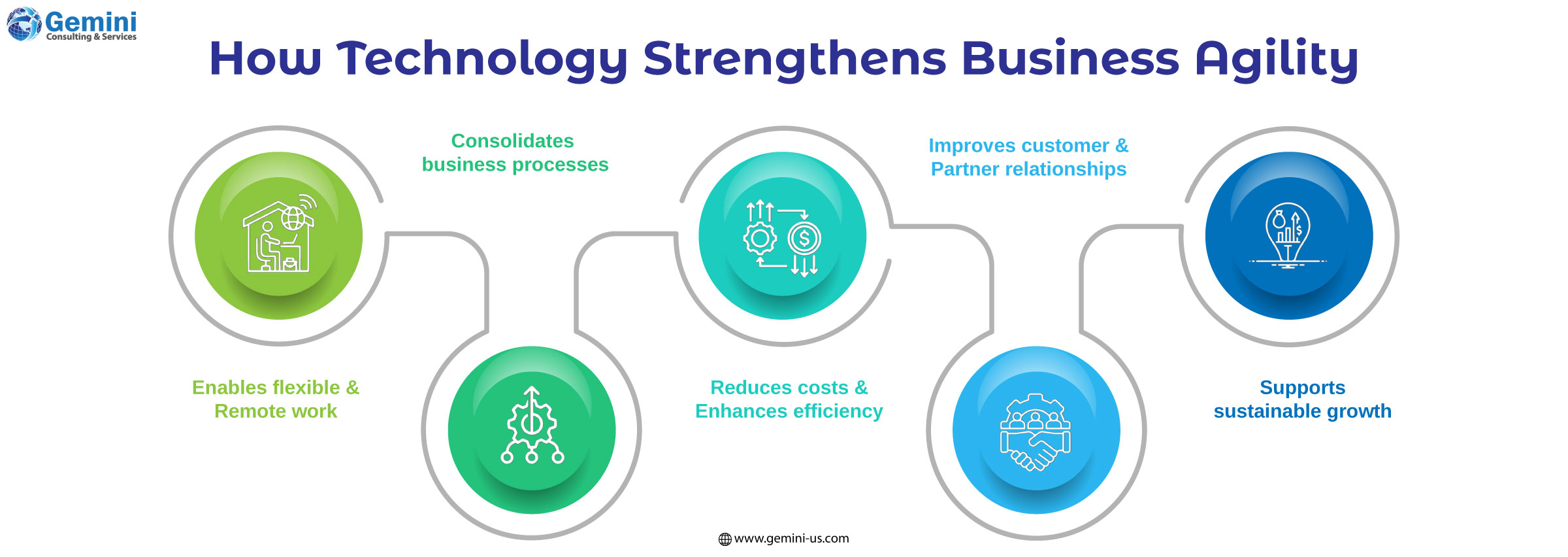
Enables Flexible and Remote Work
Technology allows employees to access business applications, collaborate with colleagues, and manage daily operations from any location. Enterprise platforms such as ERP systems provide centralized access to business data, ensuring continuity even during unexpected disruptions.
This flexibility helps organizations attract talent, maintain productivity, and respond quickly to changing workplace requirements.
Consolidates Business Processes
Many organizations still rely on multiple disconnected systems that create inefficiencies and communication gaps. Integrated business platforms bring finance, procurement, inventory, sales, customer service, and operations together within a single environment.
This unified approach improves data accuracy, reduces duplication, and enables faster, more informed decision-making across the organization.
Reduces Costs While Improving Efficiency
Technology helps businesses operate more efficiently by consolidating systems, automating workflows, and optimizing resource allocation. Lower operational costs improve resilience during economic uncertainty while enabling organizations to invest in innovation and future growth.
Greater efficiency also allows businesses to scale operations without proportionally increasing overhead.
Improves Customer and Partner Relationships
Agile businesses build strong relationships through transparency and responsiveness. Customer relationship management (CRM) systems, real-time inventory visibility, and order tracking solutions enable businesses to provide accurate updates, fulfill commitments, and respond quickly to customer needs.
Better communication strengthens trust while helping businesses deliver consistent customer experiences.
Supports Sustainable Growth
As organizations grow, technology provides the flexibility needed to handle increasing volumes of data, transactions, and customer interactions. Cloud platforms, scalable infrastructure, and automated processes enable businesses to expand efficiently without sacrificing operational performance.
This scalability ensures companies can respond to spikes in demand while maintaining service quality.
Emerging Technologies Accelerating Agility
Several technologies continue to reshape how organizations innovate and compete:
- Big Data Analytics helps uncover trends, optimize operations, and improve strategic decision-making.
- Artificial Intelligence and Machine Learning automate complex processes, personalize customer experiences, and generate predictive insights.
- Internet of Things (IoT) technologies generate real-time operational insights that support predictive maintenance, improve supply chain transparency, and enable more efficient resource utilization and decision-making.
- Cloud Platforms offer the flexibility to rapidly deploy new applications, expand infrastructure, and support continuous innovation.
Together, these technologies enable organizations to move from reactive decision-making to proactive business management.
People Remain the Key to Success
While technology provides the capabilities for agility, people ultimately drive transformation. Successful organizations invest not only in digital tools but also in employee training, leadership development, and a culture that encourages innovation and continuous improvement.
Employees who understand and embrace new technologies are better equipped to identify opportunities, solve problems, and adapt to changing business conditions. Organizations that combine modern technology with an agile mindset are far more likely to thrive in competitive markets.
The right technology strategy can help your organization become more agile, resilient, and prepared to adapt to evolving business demands. At Gemini Consulting & Services, we provide tailored technology solutions that address your unique goals and challenges. Connect with us to explore how our innovative services can accelerate your digital transformation, optimize operational performance, increase business agility, and support lasting, sustainable growth.
Conclusion
Business agility is no longer optional, it is essential for long-term success. Technology provides the infrastructure that enables organizations to adapt quickly, streamline operations, make data-driven decisions, and respond confidently to changing market conditions.
From cloud computing and AI to automation and collaboration platforms, digital technologies empower businesses to become more resilient, efficient, and customer-focused. However, lasting agility comes from pairing these technologies with a culture of continuous learning and adaptability. Organizations that successfully combine both will be well-positioned to innovate, grow, and lead in an increasingly dynamic business environment.