
Digital transformation is often viewed as a technology challenge. Organizations invest in AI, cloud platforms, automation, analytics, and new digital processes with the expectation that technology will automatically deliver better results.
But technology alone does not create transformation.
The real difference between a successful transformation and an expensive technology rollout is people. Employees must understand the purpose of change, develop the skills to work differently, and have the confidence and support to adopt new ways of working. Without this human dimension, even the most sophisticated digital strategy can struggle to deliver measurable value.
Why People Determine Transformation Success
Digital transformation changes more than systems. It changes responsibilities, processes, decision-making, reporting structures, and everyday habits.
Employees naturally tend to rely on familiar processes because they feel predictable and safe. When a new platform or workflow is introduced, people may continue using spreadsheets, email approvals, manual reports, or legacy processes. This can quietly undermine the benefits of the new technology.
Resistance is often not resistance to technology itself. It is resistance to uncertainty.
Employees may ask:
- Will my role change?
- Do I have the skills to use the new tools?
- Will automation make my job less important?
- Who is responsible for the new process?
- What happens if the new system does not work?
Organizations that address these concerns early are far more likely to achieve sustainable adoption.
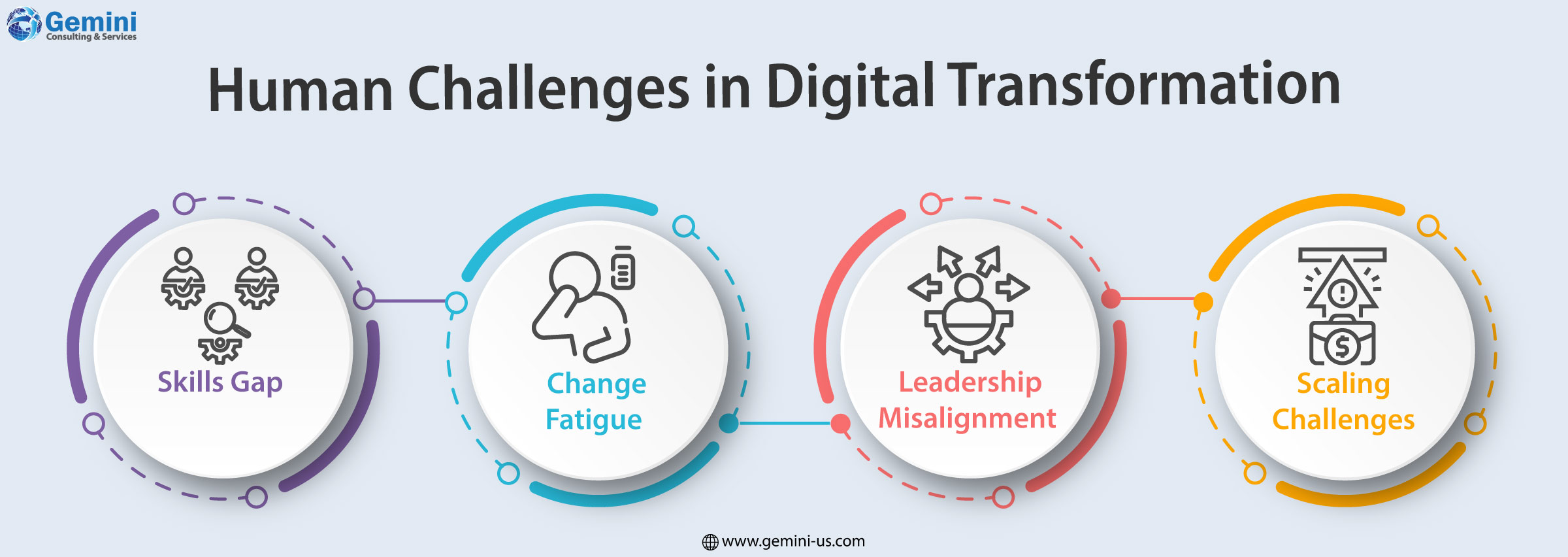
1. Skills Do Not Match the New Technology
Introducing advanced technology without preparing employees creates friction. The growing adoption of AI, data analytics, automation, and cloud technologies is creating demand for new skill sets and, in some instances, redefining existing roles.
Organizations should therefore invest in continuous learning, practical training, digital literacy, and role-specific development. The goal is not simply to teach employees how to operate a system, but to help them understand how the technology improves the way they work.
2. Employees Experience Change Fatigue
Employees can become overwhelmed when one transformation follows another. If every initiative feels like another top-down instruction, engagement quickly declines.
Leaders need to explain the reason behind the change and connect it to employees' everyday responsibilities. When people understand the purpose and see how the transformation benefits both the organization and their own careers, they are more likely to participate.
3. Leadership Is Not Aligned
Even with strong leadership support and a well-defined strategic vision, a transformation initiative can struggle or fail when it comes to practical execution.
Senior leaders may support the strategy while middle managers continue using old reporting methods or fail to reinforce new processes. Middle management is therefore critical: managers translate strategic goals into daily behavior.
Leaders must agree on priorities, responsibilities, decision rights, and expected outcomes. They also need to actively remove obstacles rather than simply sponsor the initiative from a distance.
4. Successful Pilots Fail to Scale
A successful pilot proves that something can work. It does not necessarily prove that an organization can adopt it at scale.
To move beyond the pilot stage, organizations need clear adoption measures, feedback mechanisms, accountable owners, and local champions who can support their colleagues. Without these elements, promising projects can remain isolated experiments.
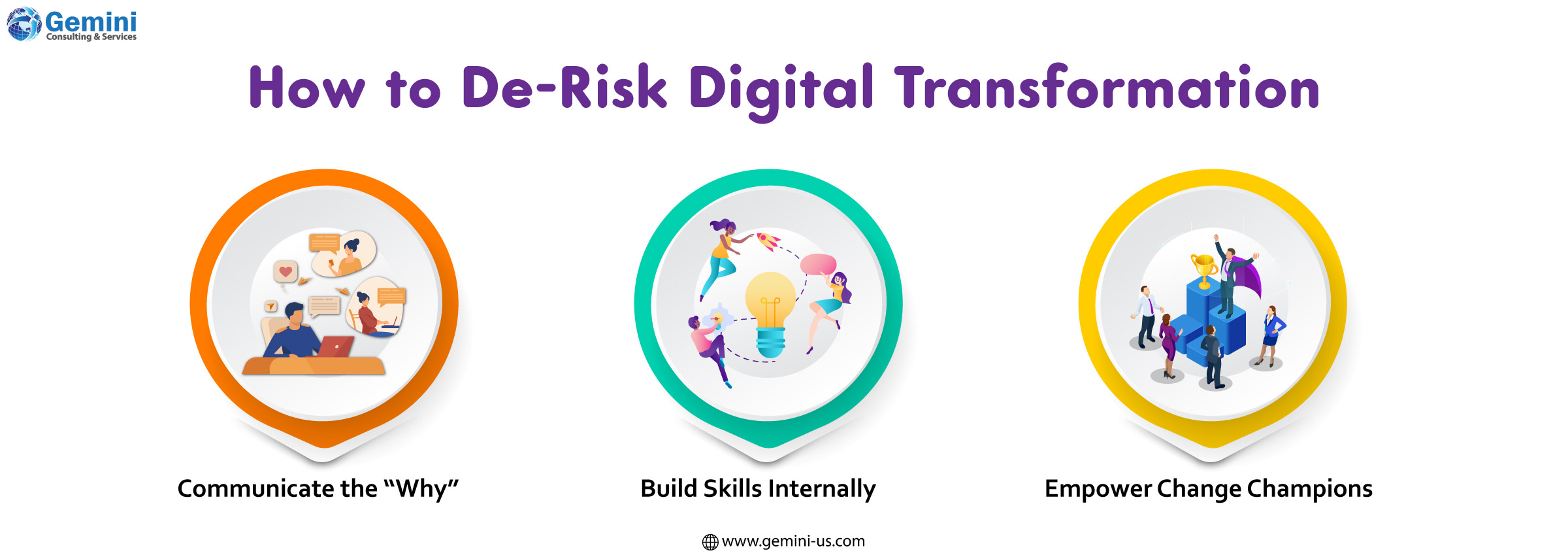
1. Communicate the "Why"
Employees need more than instructions about what is changing. They must be aware why this change is important for an organizatione.
Leaders should communicate the business objectives, expected benefits, potential challenges, and impact on employees in clear and practical terms. Honest communication creates trust and helps replace uncertainty with a shared sense of purpose.
2. Build Skills from Within
The skills needed today may not remain relevant in the future. Organizations should embed continuous learning into everyday work instead of viewing training as a one-time initiative completed before implementation.
Practical training, mentoring, career development, and opportunities to experiment with new technologies can help employees build confidence. Developing internal talent also reduces dependence on constant external hiring and creates a more adaptable workforce.
3. Develop Change Champions
Sustainable transformation cannot depend entirely on executives or project teams. Organizations should identify influential employees who understand the change and are willing to support their colleagues.
These champions can answer questions, share practical experiences, identify problems, and provide feedback to transformation leaders. Because they are part of the workforce, they can make change feel more relevant and achievable.
Make Human Change Part of Transformation Governance
The human factor should not be treated as a separate "soft" component of transformation. It should be incorporated into governance and performance management.
Every transformation workstream should clearly identify:
- Who owns the initiative
- Who sponsors it
- Which business processes will change
- Which employees are affected
- What training is required
- What behavior must change
- What evidence will demonstrate adoption
- What risks and dependencies exist
- What conditions must be met for closure
This approach turns organizational change from an abstract concept into something that can be managed and measured.
Measure Adoption Through Evidence
Training attendance or employee surveys alone cannot demonstrate successful adoption. Organizations should look for operational evidence that new ways of working have become part of everyday business.
Useful indicators include process usage, exception rates, training completion, approval times, decision delays, policy compliance, ticket-routing accuracy, milestone completion, and reductions in duplicate spreadsheets or manual reports.
For transformation leaders, this evidence provides a clearer picture of where adoption is strong and where intervention is required.
Stop Reporting in Ways That Reinforce Old Habits
One of the most overlooked barriers to transformation is outdated reporting.
If employees still have to consolidate spreadsheets, chase email updates, recreate presentations, and maintain separate trackers, the organization may be using new technology while operating through old behaviors.
A stronger transformation office establishes a consistent reporting rhythm with controlled visibility into milestones, risks, dependencies, decisions, implementation status, potential value, and closure evidence.
Reducing manual reporting gives teams more time to focus on problem-solving, risk management, dependency resolution, and value creation.
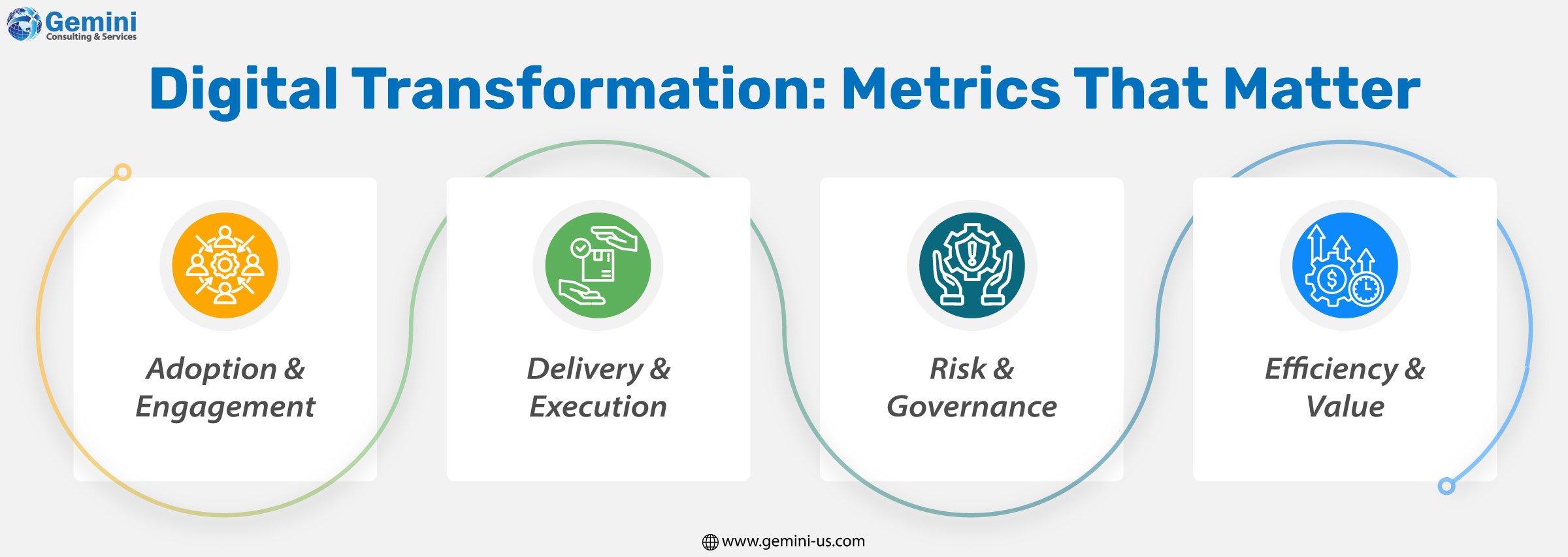
Transformation leaders should measure both technology progress and organizational adoption.
Important measures can include:
- Business adoption by department or business unit
- Initiative and workstream completion
- Training and capability development
- Decision and approval ageing
- Dependency and risk resolution
- Reporting accuracy and timeliness
- Process compliance
- Resource allocation
- Manual reporting effort
- Baseline, forecast, and actual business value
These measures help leadership determine whether transformation is producing genuine operational change rather than simply reaching technology milestones.
Common Mistakes to Avoid
Organizations should avoid treating culture as communication alone. Communication is important, but successful transformation also requires clear accountability, decision rights, governance, and measurable adoption.
They should also avoid assuming that users will automatically adopt a new process after training or system launch. Adoption needs to be monitored continuously.
Sponsors must remain actively involved by making decisions, removing dependencies, supporting accountability, and reinforcing the desired behaviors.
Most importantly, organizations should not confuse a technology go-live with transformation. A new platform is only the beginning. True transformation occurs when people change how they make decisions, perform processes, collaborate, report progress, and create value.
At Gemini Consulting & Services, we help organizations achieve greater productivity through employee-focused digital transformation. Our people-first approach enables businesses to embrace digital change smoothly, minimize disruption, and accelerate growth. Contact us to discover how we can help your organization thrive in the digital era.
Your People Are the Transformation Strategy
Sustainable digital transformation is ultimately a people challenge supported by technology.
Organizations that focus only on platforms and processes may achieve implementation without achieving adoption. Those that invest in skills, leadership alignment, accountability, decision-making, and employee engagement create a stronger foundation for lasting change.
The human factor should therefore be built into the transformation strategy from day one.
When people understand the purpose, have the skills to succeed, receive support from leaders, and see evidence that their contribution matters, technology becomes more than a new tool. It becomes an enabler of better decisions, stronger processes, and continuous innovation.
The technology may start the transformation, but people are what make it sustainable.