
Choosing an Enterprise Resource Planning (ERP) system is a major decision for any manufacturing business. The right ERP can connect departments, streamline processes, improve visibility, and support better decision-making. However, businesses must determine how the ERP should be deployed before selecting the software.
The three common options are cloud ERP, on-premise ERP, and hybrid ERP. Each model offers different advantages in terms of cost, control, scalability, customization, security, and maintenance.
With more organizations adopting cloud technologies, the ERP landscape is changing rapidly. At the same time, many manufacturers continue to rely on on-premise systems because of existing investments, specialized requirements, or regulatory considerations. Enterprises should carefully analyze the pros and cons to make an informed choice.
What Is Cloud ERP?
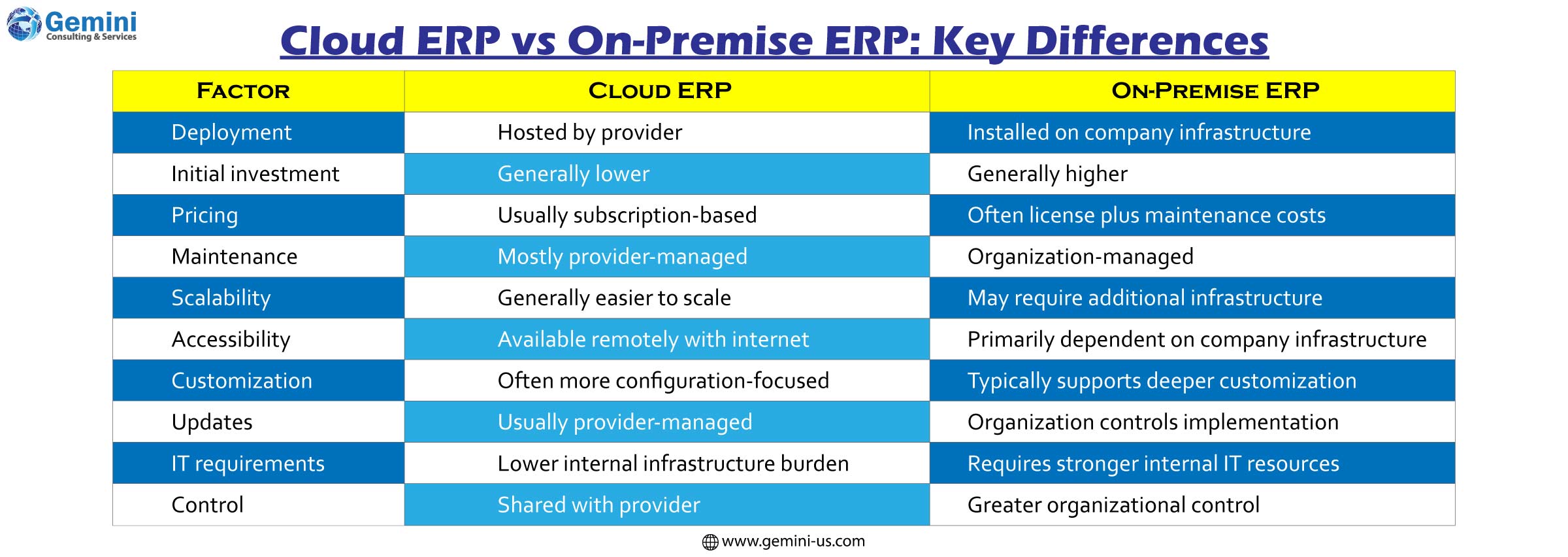
ERP providers themselves manage the hosting servers for Cloud ERP and users can access it through the internet. Instead of purchasing and maintaining extensive hardware, businesses typically pay a recurring subscription fee.
The provider generally manages infrastructure, system maintenance, security updates, backups, and software upgrades.
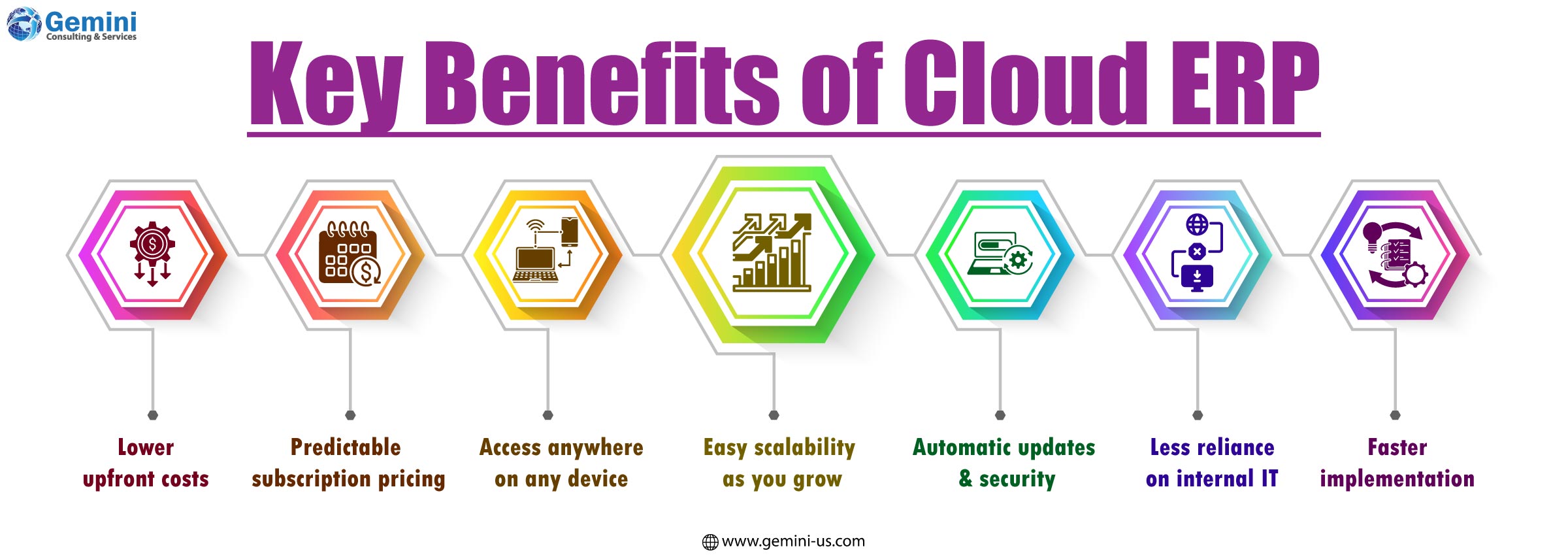
- Lower initial infrastructure investment
- Subscription-based and more predictable costs
- Access from multiple locations and devices
- Easier scalability as the business grows
- Automatic updates and security patches
- Reduced dependence on internal IT infrastructure
- Faster deployment compared with many traditional ERP implementations
Cloud ERP can be particularly useful for small and mid-sized manufacturers, businesses with multiple locations, and organizations that want to reduce the burden of maintaining IT infrastructure.
Potential Drawbacks
Cloud ERP also comes with considerations. Subscription expenses continue throughout the life of the system, and highly customized requirements may be more difficult to accommodate. Organizations also need reliable internet connectivity and must carefully evaluate the provider's security, compliance, backup, and service-level capabilities.
What is On-Premise ERP?
On-premise ERP is installed on servers and infrastructure owned or controlled by the organization. The organization oversees the management of hardware and software, including system updates, security measures, data backups, and regular maintenance.
This approach has traditionally been common among large manufacturers and organizations with complex processes.
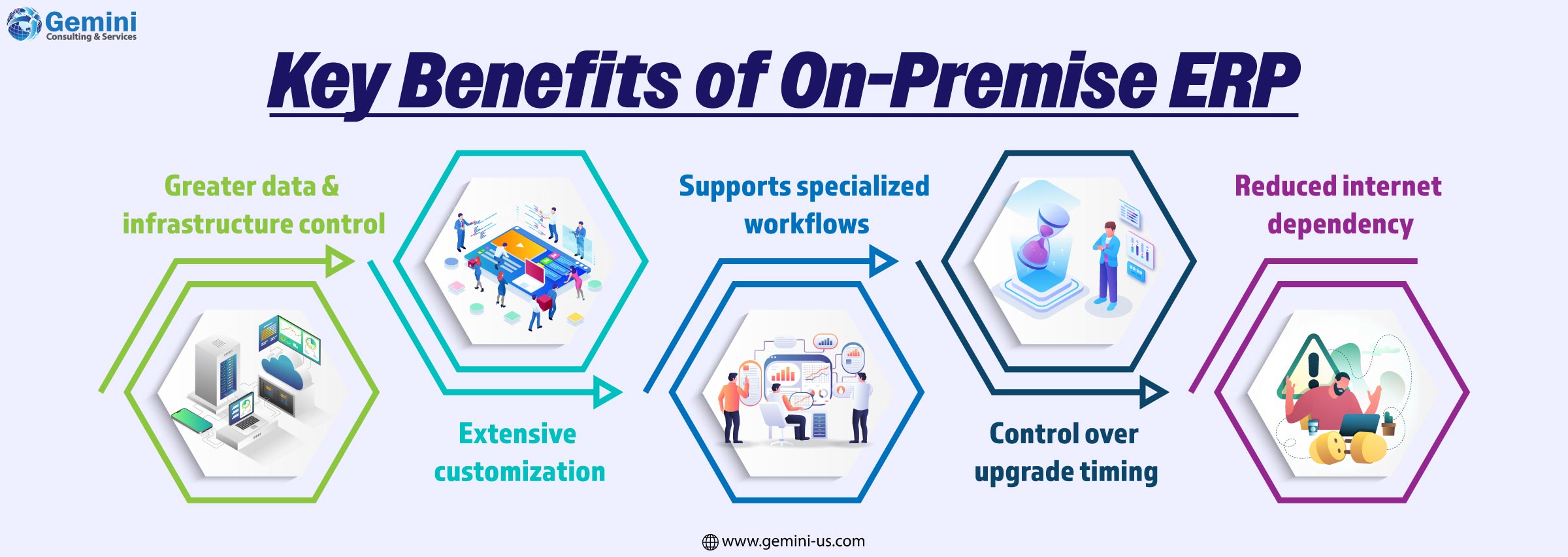
- Greater control over infrastructure and data
- Extensive customization possibilities
- Ability to support highly specialized workflows
- Greater control over upgrade timing
- Less dependence on continuous internet connectivity for internal system access
On-premise ERP can make sense when a business has significant existing infrastructure, a capable IT team, or requirements that demand extensive customization and control.
Potential Drawbacks
The main challenges include higher upfront investment, hardware and infrastructure costs, ongoing maintenance, and the need for specialized IT resources. For an expanding business, this can create challenges as it will require scaling infrastructure and additional planning.
The right choice depends on the organization's operational and strategic requirements.
What About Hybrid ERP?
Hybrid ERP combines cloud and on-premise technologies. Instead of moving everything to one environment, a business can retain selected applications or data locally while using cloud services for other functions.
For example, a manufacturer might retain a highly customized production system on-premise while adopting cloud-based applications for analytics, customer management, collaboration, or supply chain processes.
Hybrid ERP can be useful for organizations that have legacy systems but want to modernize gradually rather than replace everything at once.
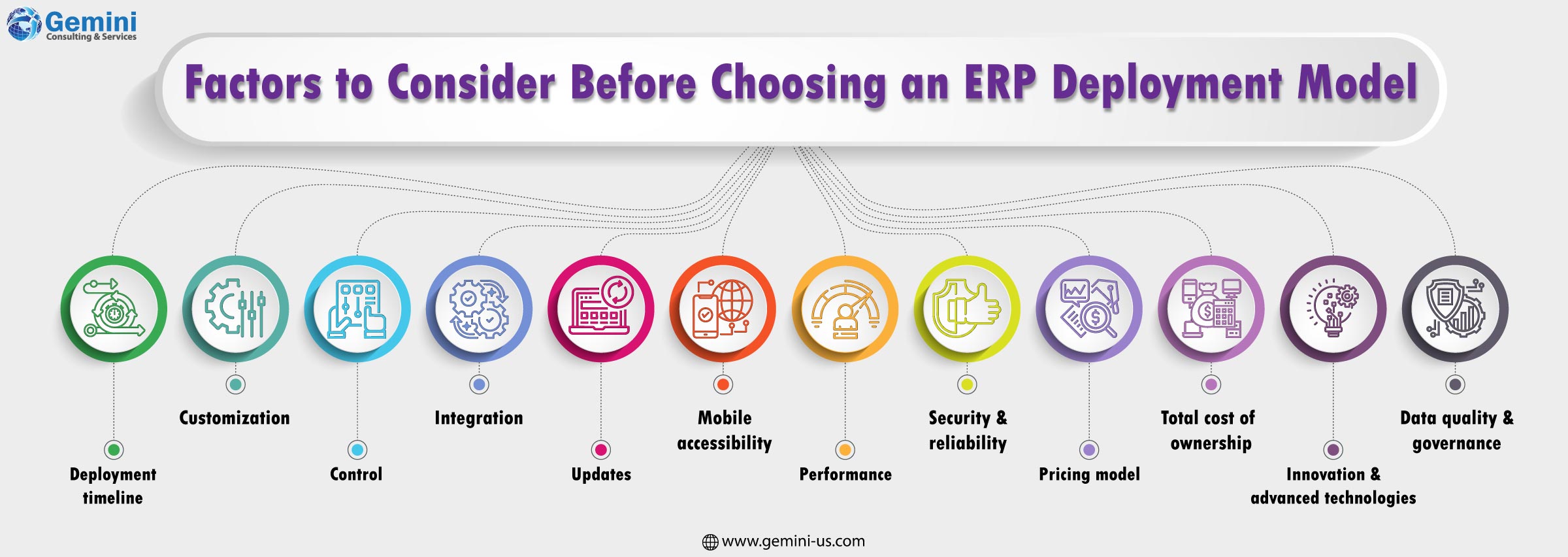
1. Deployment timeline
Cloud implementations can often be deployed faster because businesses do not need to build the same level of physical infrastructure. Complex on-premise projects may require more extensive preparation.
2. Customization
On-premise systems generally provide greater freedom for custom development. Cloud ERP typically emphasizes standardization and configuration, which can simplify upgrades but may restrict certain specialized modifications.
3. Control
Businesses that require direct control over infrastructure and data may prefer on-premise deployment. Cloud users instead rely on the provider for much of the underlying environment.
4. Integration
Both deployment models can support integrations, but capabilities vary significantly between individual ERP products. Evaluate APIs, connectors, middleware, and compatibility with existing applications before making a decision.
5. Updates
Cloud providers generally manage updates and new releases. On-premise organizations have greater control over when upgrades are introduced but must manage the associated work themselves.
6. Mobile Accessibility
Cloud ERP typically makes remote access easier because applications are designed to operate through internet-connected devices. On-premise systems may require additional infrastructure for secure remote access.
7. Performance
Cloud systems can provide scalable computing resources, but performance depends partly on network connectivity. On-premise systems can provide predictable local access but may require infrastructure upgrades as workloads increase.
8. Security & Reliability
Security should not be judged solely by whether an ERP is cloud-based or on-premise. Businesses should evaluate encryption, access controls, compliance certifications, backups, disaster recovery, monitoring, and incident-response capabilities.
9. Pricing Model
On-premise ERP usually involves greater upfront expenditure, while cloud ERP spreads costs through recurring subscriptions. Organizations should compare the complete financial picture rather than focusing only on initial price.
10. Total Cost of Ownership
Consider implementation, infrastructure, IT staffing, support, upgrades, customization, training, integrations, and future expansion. A lower upfront cost does not automatically mean a lower long-term cost.
11. Innovation & Advanced Technologies
Cloud platforms are often closely connected with newer capabilities such as artificial intelligence, automation, analytics, and frequent software enhancements. Businesses should examine the product's development roadmap rather than assuming all ERP platforms offer the same capabilities.
12. Data Quality & Governance
Before migrating to any new ERP environment, organizations should assess data quality, ownership, retention requirements, and regulatory restrictions. Poor-quality data can undermine reporting, automation, and AI initiatives regardless of deployment model.
How Should You Choose?
The ERP deployment model should support the business, not dictate its strategy.
Consider on-premise ERP when extensive customization, infrastructure control, or specific operational requirements are priorities and the organization has the resources to maintain the environment.
Consider cloud ERP when scalability, remote accessibility, faster deployment, predictable operating expenses, and reduced infrastructure management are important.
Consider a hybrid ERP approach when the organization needs to preserve critical legacy systems while gradually adopting cloud capabilities.
If your business is looking for a strategic partner to help you implement an ERP system, Gemini Consulting & Services can help. Contact us to learn how our experts can develop a customized ERP strategy based on a thorough analysis of your business requirements and assist you in deciding if you require on-premise or cloud-based system.
Final Thoughts
The cloud-versus-on-premise ERP debate is ultimately about more than technology. ERP systems influence manufacturing, finance, procurement, inventory, supply chain, sales, and other core business processes, making the deployment decision a long-term strategic consideration.
Rather than choosing an ERP simply because it is cloud-based or on-premise, businesses should first identify their functional requirements, regulatory obligations, existing technology investments, budget, customization needs, and growth plans.
A structured evaluation of these factors can help manufacturers select an ERP environment that supports their current operations while providing room for future growth and modernization.