
Sustainability is no longer a long-term aspiration. It is becoming a measurable business priority. By 2026, information technology is evolving into the “central nervous system” of sustainable energy, helping organizations integrate AI, automation, digital twins, and advanced analytics to drive operational efficiency and environmental impact at scale.
For businesses across industries, technology is transforming sustainability from fragmented initiatives into intelligent, connected ecosystems that support both growth and climate goals.
The International Energy Agency (IEA) reports that the worldwide market for clean energy technologies expanded at an average annual rate of 20% over the last ten years, reaching close to $1.2 trillion by 2025. Under the Current Policies Scenario (CPS), growth is projected to be slower than in other scenarios, yet the market is still expected to double to nearly $2 trillion by 2035, approximately equivalent to the size of the global crude oil market in 2025.
Sustainable technology trends in 2026 will reshape how businesses and consumers interact with energy, computing, and waste management. The push towards net-zero emissions has accelerated investment in green innovation. Companies across industries now place environmental responsibility alongside profitability.
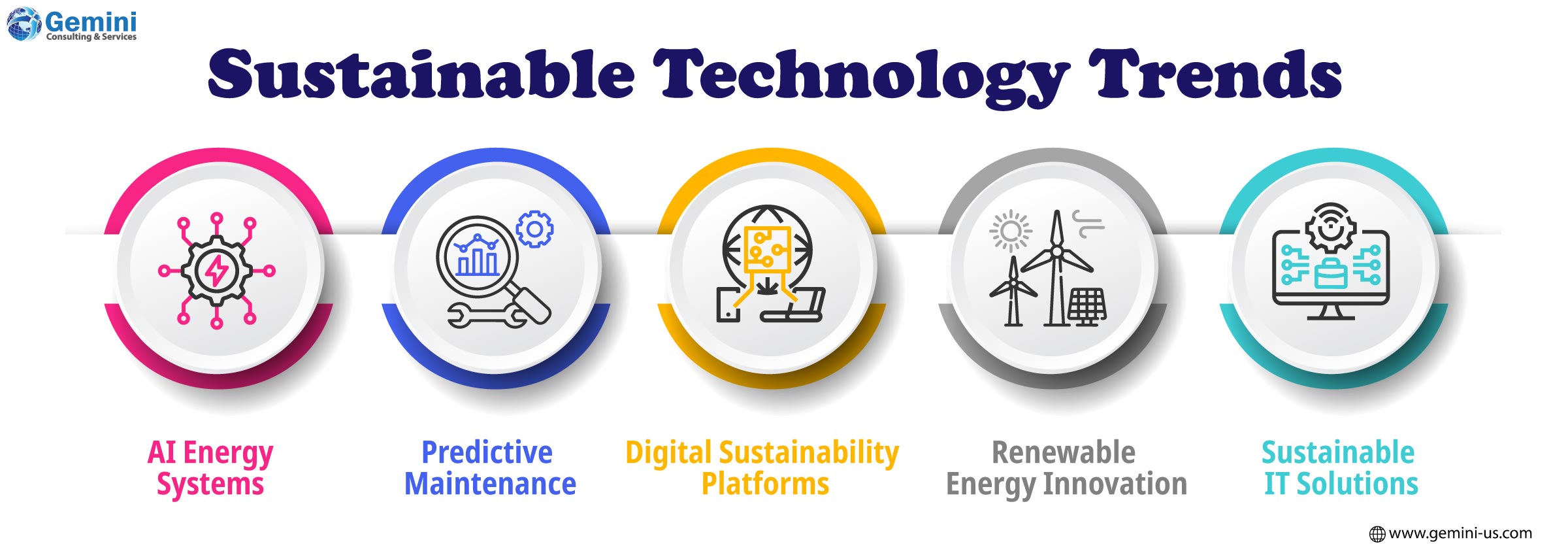
This year marks a turning point. Battery storage systems are becoming cheaper, while AI tools can now predict and reduce energy waste with remarkable accuracy. E-waste recycling has also become a billion-dollar industry.
AI-Driven Energy Systems
Artificial Intelligence is reshaping the way energy is generated, distributed, and consumed. Modern AI-powered grid management systems can analyze energy demand in real time, optimize power distribution, and autonomously manage distributed assets such as EV charging stations, HVAC systems, and renewable energy sources.
This shift is creating smarter, more adaptive grids capable of balancing fluctuating energy demand while improving resilience and reducing operational costs. AI is also helping utilities forecast energy usage, identify inefficiencies, and optimize renewable energy integration more effectively than ever before.
Predictive Maintenance and Self-Healing Infrastructure
Machine learning is enabling a new generation of predictive maintenance solutions. By analyzing sensor data and infrastructure performance, AI models can detect anomalies in transformers, transmission lines, and grid systems weeks before failures occur.
This proactive approach minimizes downtime, reduces maintenance costs, and supports the development of “self-healing” energy infrastructure. For energy providers and industrial enterprises, predictive analytics is becoming critical for ensuring reliability and business continuity.
Digital Platforms Driving Sustainability
Data has become the foundation of modern sustainability strategies. Organizations are increasingly adopting integrated digital platforms that provide real-time visibility into emissions, energy consumption, resource utilization, and supply chain performance.
These platforms help businesses move beyond manual reporting and static spreadsheets, enabling data-driven decision-making across operations. Advanced analytics and AI-powered dashboards allow organizations to identify waste, improve efficiency, and measure sustainability outcomes with greater accuracy.
Supply chain optimization is another major area of transformation. Intelligent digital systems now provide end-to-end visibility across supplier networks, helping companies reduce emissions, improve procurement practices, and eliminate operational inefficiencies. As logistics contributes significantly to global greenhouse gas emissions, AI-driven optimization is becoming essential for sustainable operations.
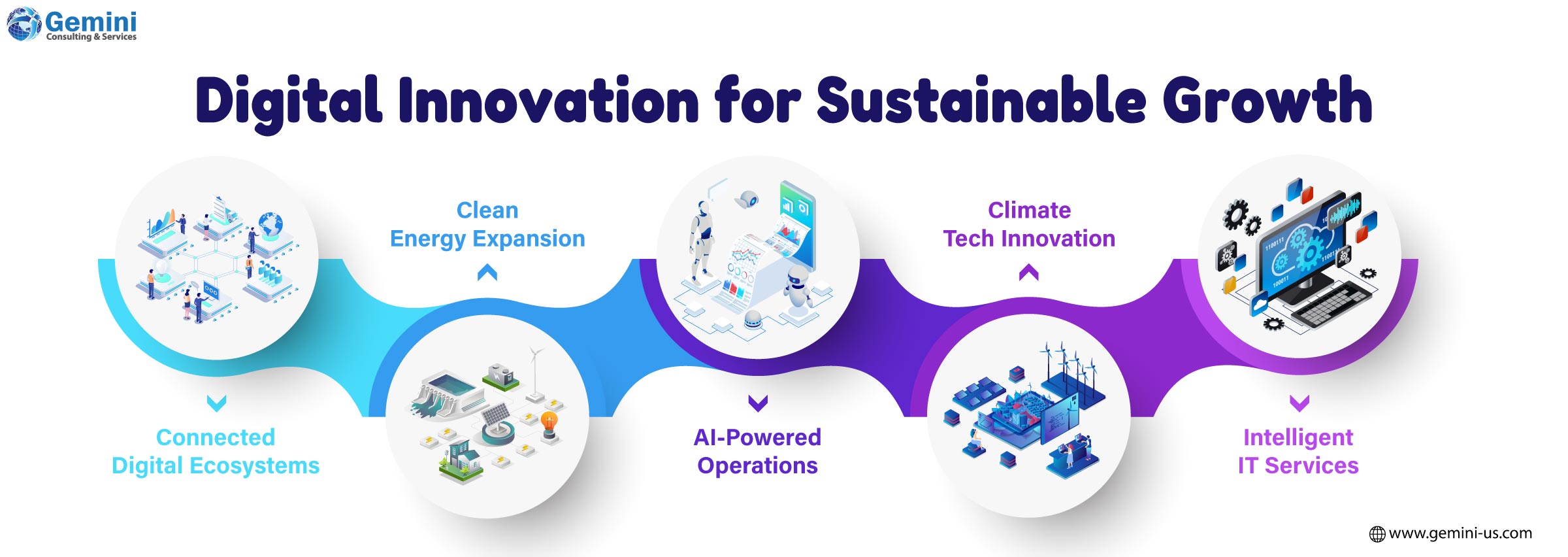
Gemini Consulting & Services offers digital platforms that can help energy companies improve efficiency and scale their operations in a sustainable manner. Contact us to discover how our energy sector specialists can support your growth strategy and roadmap development.
Renewable Energy and Storage Innovation
The rapid growth of solar, wind, and green hydrogen is accelerating demand for advanced digital infrastructure. IT services are playing a key role in enabling this transition through technologies such as Geographic Information Systems (GIS), 3D modeling, and digital twins.
These tools support the deployment and management of battery storage systems, improve energy forecasting, and optimize infrastructure planning. Modernized grids combined with next-generation battery technologies are creating more flexible and resilient energy ecosystems capable of supporting increasing electricity demand.
As AI and digital infrastructure continue to expand globally, the need for scalable, efficient, and sustainable energy systems will only grow stronger.
Sustainability Embedded into Operations
One of the biggest shifts in 2026 is the integration of sustainability into day-to-day business operations. Technology is enabling organizations to embed sustainability into procurement, workplace management, logistics, and enterprise decision-making.
AI-powered platforms are simplifying operational workflows while improving efficiency and reducing environmental impact. Even small advancements, like minimizing resource waste or improving energy efficiency, can now be implemented across worldwide operations using intelligent automation and data-driven analytics.
This represents a major evolution from simply tracking sustainability metrics to actively shaping sustainable outcomes in real time.
The Next Frontier of Climate Technology
Innovation in climate technology is accelerating rapidly. Emerging solutions include advanced battery chemistries, AI-powered environmental monitoring systems, smart sensor networks, and low-emission industrial technologies.
At the same time, investment in clean energy technologies continues to rise globally. The clean energy market has already surpassed trillion-dollar scale and is expected to grow significantly over the next decade. Electric vehicles, low-emission fuels, renewable infrastructure, and energy-efficient materials are creating new opportunities for businesses willing to embrace digital transformation.
However, as policies, market conditions, and technologies continue to evolve, organizations need flexible and future-ready IT ecosystems to adapt successfully.
The Role of IT Services Companies
For IT services companies, this transformation presents a significant opportunity. Businesses today require technology partners that can help them modernize infrastructure, integrate AI solutions, optimize energy systems, and build intelligent sustainability platforms.
From cloud-based analytics and automation to digital twins and predictive maintenance, IT services are becoming essential for enabling sustainable innovation at scale.
The future of sustainability will not be driven by a single technology, but by connected digital ecosystems that combine intelligence, automation, and operational visibility. Organizations that invest in these capabilities today will be better positioned to improve efficiency, reduce environmental impact, and lead the transition toward a smarter, greener future.
In 2026, economic pressure and the need for companies to control costs more effectively are accelerating the adoption of an essential concept: Sustainable IT.
Sustainable IT in 2026 is an integrated approach that combines energy efficiency, automation, and environmental responsibility to reduce consumption, digital waste, and operational costs.
Sustainable technology trends in 2026 represent significant shifts in how technology is built, deployed, and retired.