Legacy applications remain the backbone of many enterprises. Systems built 10, 20, or even more years ago continue to support finance, ERP, CRM, supply chain, manufacturing, banking, HR, and customer operations. Yet the same platforms that once enabled growth can eventually become obstacles to scalability, integration, automation, and innovation.
The challenge is clear: how can organizations modernize critical applications without interrupting the business they support?
The answer is not a risky, one-time replacement. Successful modernization requires a structured, incremental strategy that balances technology transformation with operational continuity.
According to Mordor Intelligence, the global legacy modernization market is projected to reach $29.39 billion in 2026, up from $24.98 billion in 2025. The market is expected to expand further to $66.21 billion by 2031, representing a 17.64% CAGR between 2026 and 2031. This rapid growth highlights the increasing need for organizations to address technical debt while leveraging cloud-native capabilities and AI-powered efficiencies.
Why Legacy Modernization Can No Longer Wait
Enterprises are under growing pressure to adopt cloud platforms, enable AI and advanced analytics, integrate with modern applications, and meet increasingly demanding security and compliance requirements.
However, traditional architectures can make these goals difficult to achieve. Monolithic designs, outdated frameworks, tightly coupled integrations, data silos, and accumulated technical debt can slow development and increase maintenance costs.
Recent IDC research highlights the connection between legacy application challenges and enterprise AI adoption, noting that around 90% of organizations remain caught in reactive modernization cycles, with data debt contributing to higher transformation risks.
Forrester research similarly emphasizes that inflexible legacy applications can constrain business growth, consume maintenance budgets, and make digital transformation more difficult.
The business consequences extend beyond IT. Slow feature delivery, limited scalability, manual processes, integration challenges, and rising maintenance demands can directly affect customer experience and competitiveness.
The Real Risk: Modernizing Too Much, Too Fast
Organizations often hesitate to modernize because mission-critical applications cannot simply be switched off while new systems are built.
A poorly planned transformation can create downtime, data inconsistencies, integration failures, compliance gaps, unexpected costs, and resistance from employees who depend on established workflows.
That is why the traditional “big-bang” migration is rarely the safest option.
Instead, organizations should treat modernization as a controlled evolution.
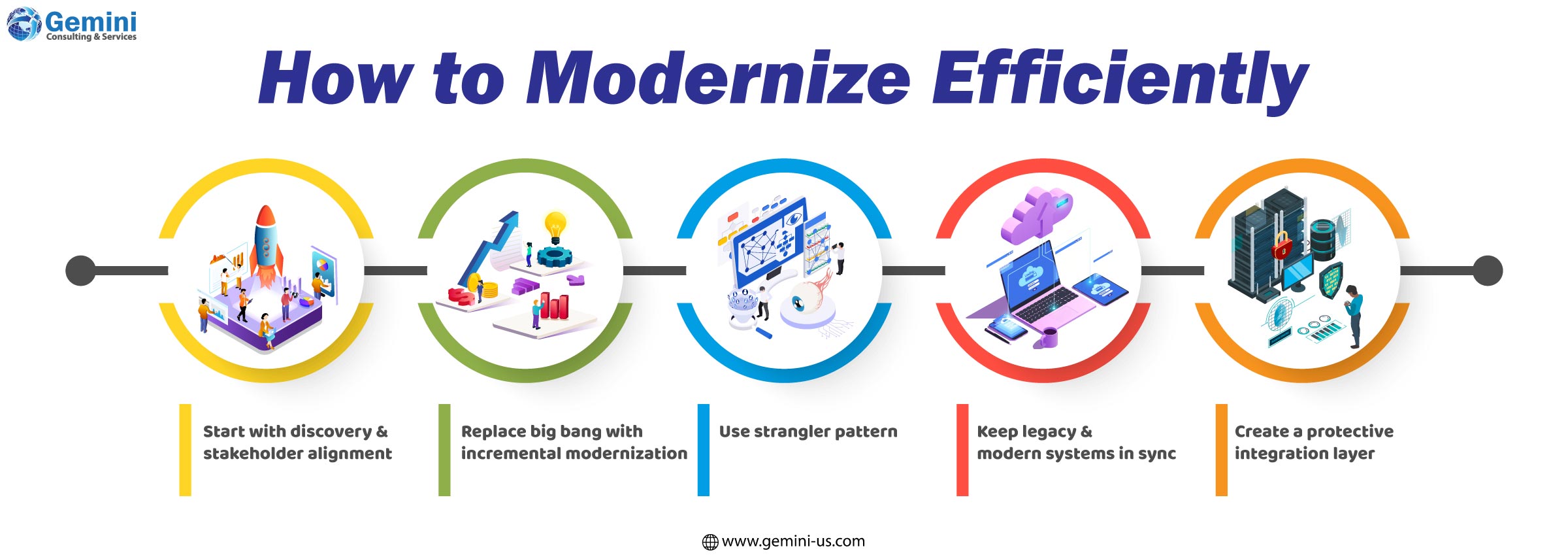
1. Start With Discovery and Stakeholder Alignment
Before changing technology, understand the business it supports.
A comprehensive assessment should map application architecture, integrations, dependencies, business rules, data flows, performance requirements, and technical debt. Equally important is documenting the processes embedded within the existing application.
Business and technology stakeholders should agree on:
- What functionality must be retained
- What should be redesigned or improved
- What can be retired
- Which integrations are business-critical
- What regulatory and security requirements apply
- How success will be measured
This discovery phase creates a shared blueprint and reduces the likelihood of modernizing the technology while accidentally removing essential business functionality.
2. Replace the Big Bang with Incremental Modernization
A phased approach allows organizations to modernize manageable portions of an application while keeping the wider environment operational.
Pilot projects are particularly valuable. They allow teams to validate architecture, functionality, integrations, security, performance, and user acceptance before expanding the transformation.
Intermediate checkpoints also create opportunities to incorporate lessons learned. Instead of discovering a major problem after a multi-year migration, organizations can identify and correct issues while the scope is still manageable.
3. Use the Strangler Pattern
The Strangler Pattern is one practical way to gradually replace legacy functionality.
Rather than rebuilding an entire monolithic application simultaneously, organizations identify specific capabilities and progressively move them to modern services or applications. New and legacy components can coexist during the transition, with functionality shifting gradually toward the modern platform.
This approach reduces the blast radius of individual changes and provides a clear path toward eventual legacy retirement.
4. Keep Legacy and Modern Systems in Sync
One of the most overlooked modernization risks is assuming that the legacy system will remain unchanged during migration.
In reality, business rules, security controls, regulations, integrations, and operational requirements continue to evolve. If changes made to the existing application are not captured and incorporated into the modernization effort, the new platform can become technically modern but functionally outdated.
Organizations should therefore establish processes for continuously tracking legacy changes and transferring relevant updates into the modernization backlog.
Data synchronization is equally important. During phased migrations, validation, reconciliation, and controlled data replication can help ensure that both environments remain accurate and reliable.
5. Create a Protective Integration Layer
APIs and API gateways can provide an abstraction layer between legacy applications and modern technologies.
Rather than immediately altering the core system, organizations can expose selected capabilities through APIs and connect them to cloud platforms, modern applications, analytics tools, or third-party services.
This creates flexibility while reducing direct dependencies on legacy code. It also allows modernization to progress at a pace that matches business priorities.
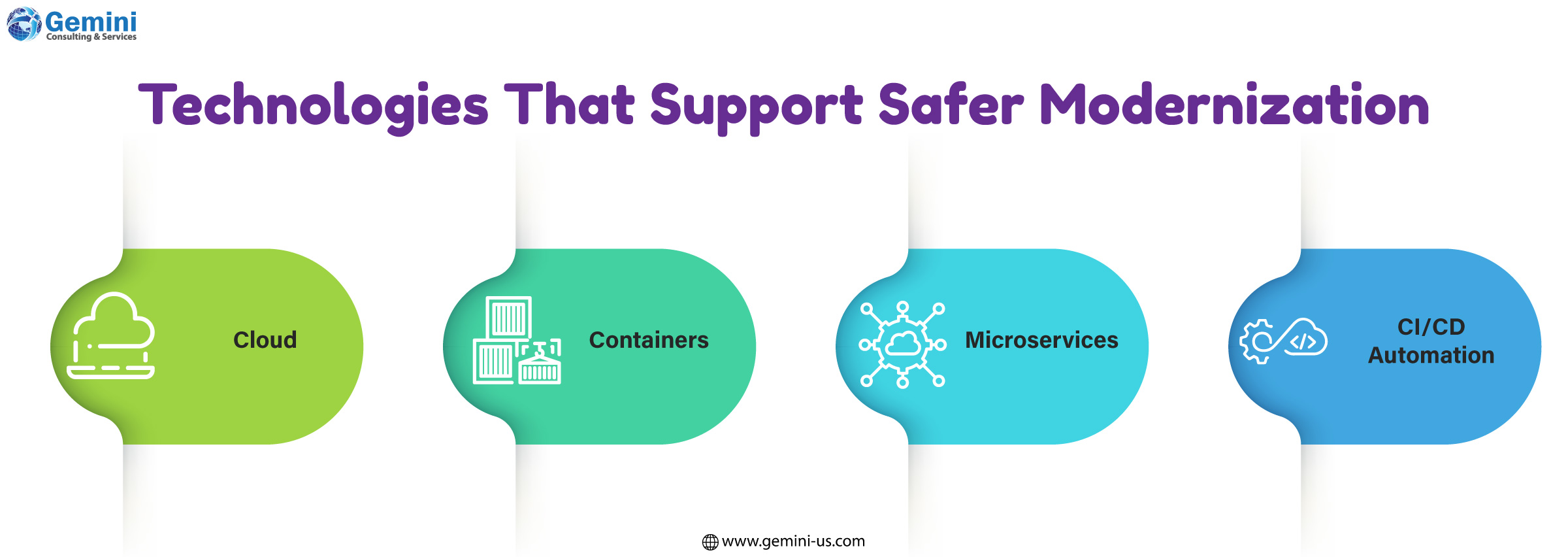
Modernization is not simply about moving applications to the cloud. The supporting technology strategy matters just as much.
While cloud platforms help offer scalability and access to modern infrastructure and services, containers are often used to create consistent environments across development, testing, and production. Microservices enable individual capabilities to be developed and scaled independently.
Meanwhile, CI/CD automation helps teams test and release changes consistently, while observability platforms provide visibility into logs, metrics, traces, application health, and performance.
Together, these capabilities create the foundation for controlled and measurable transformation.
Legacy Systems Have Become a Governance Concern
Legacy applications still sit at the heart of many enterprises, supporting critical functions such as billing, reporting, customer information, and compliance processes. The primary challenge is no longer simply system performance—it is the growing risk of instability, dependency, and limited maintainability.
- Production applications built on outdated or unsupported frameworks
- Critical systems understood by only a small number of technical specialists
- Business logic closely intertwined with underlying infrastructure
- Release processes where every change carries significant operational risk
Modernization therefore has become an essential part of enterprise risk management.
Modernizing Without Disrupting Production
We take a measured approach to modernization rather than replacing legacy platforms all at once. Our methodology focuses on making each stage of transformation controlled, observable, and reversible when necessary.
Observe: Build a clear picture of how the existing environment works through dependency mapping, application analysis, and data-flow assessment.
Isolate: Create abstraction and integration layers that prevent legacy architectural limitations from being carried into newly developed components.
Extract: Gradually transform individual business capabilities while keeping the existing platform operational and available to users.
Validate: Operate modernized components alongside legacy functionality, using parallel processing and controlled traffic testing to verify performance, accuracy, and reliability.
Retire: Gradually redirect workloads to the modernized environment and decommission legacy components only after their replacements have demonstrated consistent stability and correctness.
If your organization is looking to modernize and enhance its existing technology infrastructure, Gemini Consulting & Services can guide you through every stage of the transformation. Connect with us to learn how our digital experts can create a customized modernization strategy and roadmap designed to support your business objectives.
Modernization Should Be a Continuous Journey
The objective of legacy modernization is not merely to replace old technology with new technology. It is to create an environment that can adapt as business requirements change.
The safest strategy combines deep discovery, stakeholder collaboration, incremental delivery, system synchronization, controlled data migration, and continuous monitoring.
Enterprises do not need to choose between modernization and business continuity. With the right architecture and execution model, they can pursue both.
Ultimately, modernization should be viewed as an ongoing business capability rather than a one-time IT project. By transforming applications in manageable stages while protecting existing operations, organizations can reduce risk, accelerate innovation, improve technology agility, and turn legacy environments from constraints into platforms for future growth.