
Digital transformation has evolved beyond simply migrating applications to the cloud. Today, organizations must build an integrated technology environment in which ERP, CRM, HR, supply chain systems, customer-facing applications, and third-party platforms can operate seamlessly as a unified ecosystem. As the adoption of ERP solutions continues to grow, enterprises require dependable technologies that enable them to harness data effectively and build AI-driven, intelligent business operations.
Grand View Research estimates that the global enterprise resource planning (ERP) software market will grow from approximately $83.2 billion in 2026 to $157.1 billion by 2033. This growth is projected to occur at a compound annual growth rate (CAGR) of 9.5% over the forecast period. This expansion is largely attributed to the growing need for data-driven decision-making and more efficient, streamlined business operations across industries.
As enterprises adopt more cloud services and specialized applications, disconnected systems can create duplicated data, manual processes, delayed decisions, and limited visibility. SAP Business Technology Platform (SAP BTP) addresses this challenge by providing a technology foundation for integration, application development, data management, analytics, automation, and AI.
At the center of this connected architecture is the SAP Integration Suite, which helps organizations securely connect SAP and non-SAP applications across cloud, on-premise, and hybrid environments.
What Is SAP BTP Integration Suite?
SAP Integration Suite is a collection of integration capabilities within SAP BTP designed to connect applications, data, APIs, business partners, and events.
Instead of creating separate point-to-point interfaces for every application, organizations can adopt standardized integration patterns, reusable components, APIs, connectors, and event-driven approaches.
This makes it easier to connect solutions such as SAP S/4HANA with platforms including CRM, e-commerce, HR, logistics, customer service, and other third-party applications.
A typical implementation begins by establishing an SAP BTP account and enabling the required Integration Suite capabilities through the BTP environment. Organizations can then use resources such as the SAP Business Accelerator Hub to discover APIs, integration content, connectors, and reusable integration assets.
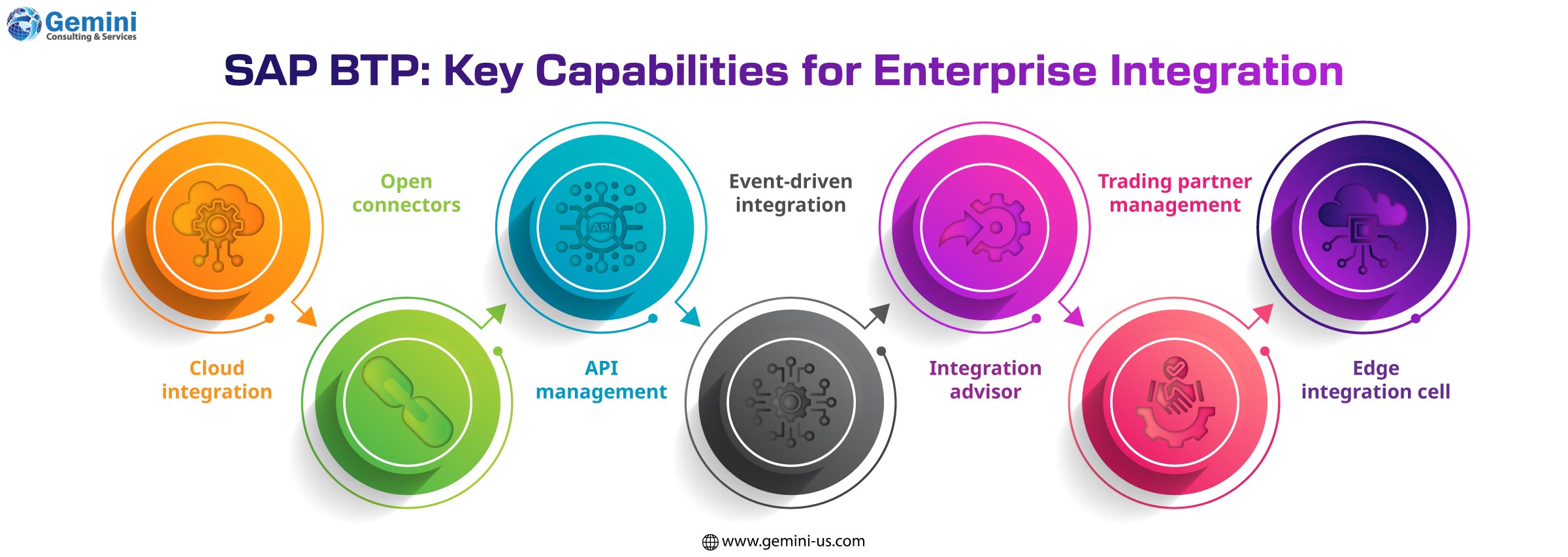
1. Cloud Integration
Cloud integration enables enterprises to deploy applications across hybrid environments. It facilitates seamless integration between applications, businesses, and government systems, supporting application-to-application (A2A), business-to-business (B2B), and business-to-government (B2G) scenarios.
Prebuilt integration content, transformation capabilities, monitoring tools, and intelligent development assistance can reduce the effort required to design and maintain interfaces.
For companies modernizing legacy middleware, Cloud Integration can also provide a path toward a more flexible, cloud-oriented integration architecture.
2. Open Connectors
Connecting to third-party applications can become complicated when every application uses different APIs and data structures.
Open Connectors simplify this process by providing standardized connectivity for commonly used business applications. They help organizations integrate external services while reducing the need to develop and maintain custom connections for every individual application, enabling information exchange to be more consistent across a diverse application landscape.
3. API Management
APIs have become an important foundation for modern enterprise architecture. SAP API Management provides capabilities for publishing, securing, governing, monitoring, and managing APIs.
Organizations can establish consistent policies around API access while creating reusable interfaces for internal teams, partners, and external applications.
A structured API strategy also supports future innovation because business capabilities can be exposed and reused without rebuilding the underlying functionality.
4. Event-Driven Integration
Not every integration needs to rely on scheduled data transfers or direct application calls. Event-driven architectures allow systems to respond when important business events occur.
For example, an order confirmation, inventory change, payment event, or shipment update can trigger downstream processes automatically.
Using event-based integration can help organizations create more responsive processes while reducing unnecessary polling and manual intervention.
5. Integration Advisor
Complex B2B and industry integrations often involve standardized message formats and detailed mapping requirements.
Integration Advisor can assist teams with message design and mapping by providing recommendations and reusable definitions, thereby reducing implementation effort. It also helps improve consistency across integration projects.
6. Trading Partner Management
Organizations that collaborate with suppliers, distributors, logistics companies, and other external partners require dependable mechanisms for establishing partnerships and exchanging business information. Trading Partner Management enables organizations to maintain partner information, define business agreements, and facilitate B2B interactions. When combined with monitoring features, it offers improved visibility into partner-related transactions and supports the management of varied integration needs.
7. Edge Integration Cell
Certain organizations may be unable or unwilling to transfer all integration workloads and sensitive information to public-cloud environments. Edge Integration Cell addresses this requirement by allowing integration services to operate within private or on-premises environments while still being administered through centralized management.
This model is especially useful in situations where regulatory obligations, security policies, data-residency requirements, or existing architectural constraints require organizations to retain greater control over the location and processing of their data.
SAP BTP Beyond Integration
Integration is only one part of the SAP BTP value proposition. The platform can also provide a foundation for extending applications, managing data, and introducing automation and AI.
Application Extensions Without ERP Customization
One of the major principles of modern SAP architecture is the clean core approach.
Instead of modifying the ERP core for every business-specific requirement, organizations can build extensions on BTP. SAP Build and development frameworks such as the Cloud Application Programming Model can be used to create applications, workflows, portals, and process extensions outside the core system.
Examples include supplier onboarding applications, approval processes, employee self-service tools, and field-service solutions.
Keeping these extensions separate from the ERP core can make them easier to evolve while reducing the potential impact of future ERP upgrades.
Data and Analytics
Connected applications are valuable only when organizations can turn their data into useful information.
SAP Datasphere can help bring together information from SAP applications and external sources while maintaining business context. This can support analytics across areas such as finance, supply chain, sales, and operations.
A connected data foundation can also provide a stronger starting point for advanced analytics and AI initiatives.
AI and Automation
AI is increasingly becoming part of enterprise workflows rather than remaining a standalone technology.
SAP BTP provides capabilities for automation and AI-enabled development, while SAP Joule can support users through conversational interactions, insights, recommendations, and workflow assistance.
Organizations can also explore more advanced agent-based approaches for coordinating tasks across multiple systems. These capabilities can help move automation from simple repetitive actions toward more sophisticated business processes.
Building an Effective SAP BTP Integration Strategy
Technology alone does not create a connected enterprise. Organizations need an integration strategy that considers architecture, security, governance, scalability, and future requirements.
If your business wants to integrate various applications and systems, Gemini Consulting & Services can help. Connect with our team to discover how our integration experts can simplify system connectivity, improve data flow, and support your organization in becoming more data-driven.
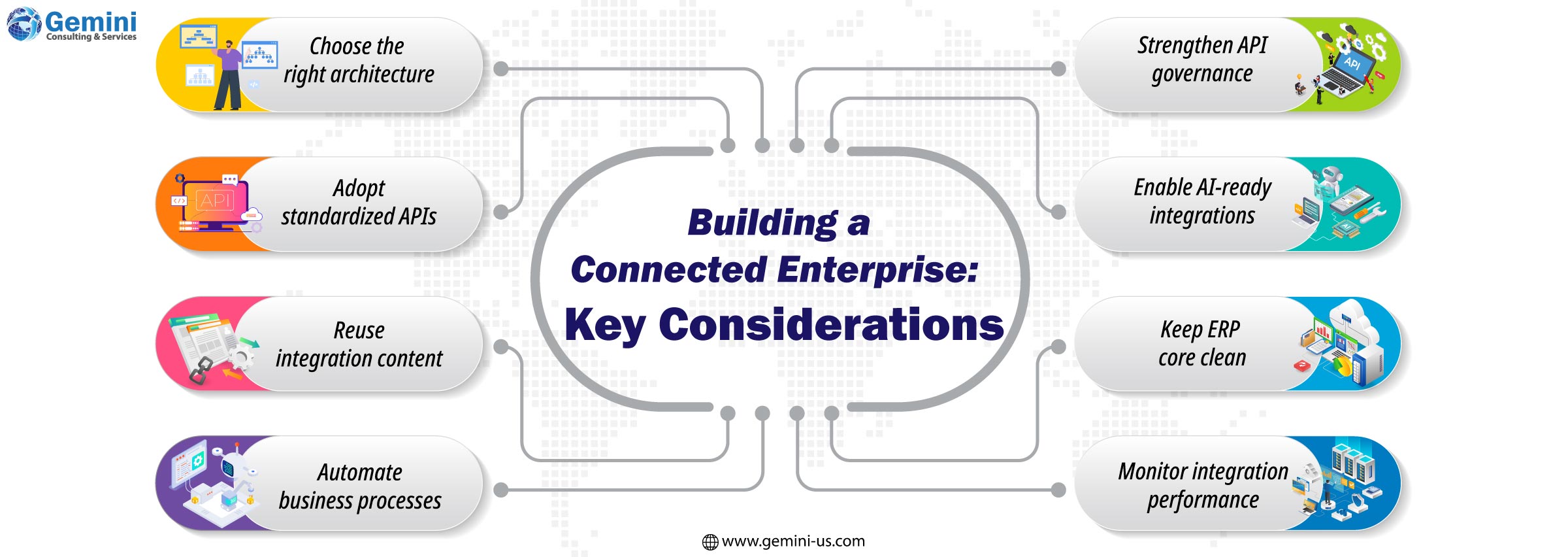
- Determine whether each workload belongs in a cloud, on-premise, or hybrid architecture.
- Use APIs and standardized integration patterns wherever practical.
- Take advantage of reusable integration content instead of repeatedly building interfaces from scratch.
- Automate routine business tasks to minimize manual effort and improve efficiency.
- Establish API security, governance, monitoring, and lifecycle management.
- Design integrations with future analytics and AI requirements in mind.
- Keep business extensions outside the ERP core where appropriate.
- Monitor integrations continuously to identify failures and performance issues.
From Connected Systems to a Connected Enterprise
The modern enterprise is made up of many applications, platforms, partners, and data sources. The goal is not necessarily to replace this diversity, but to make the entire landscape work together effectively.
SAP BTP and SAP Integration Suite provide a foundation for achieving that goal. Integration connects applications and partners, APIs make business capabilities reusable, extensions support innovation without excessive core customization, data services create a stronger analytical foundation, and AI and automation can transform how processes are executed.
The result is more than technical connectivity. A well-designed SAP BTP strategy can help create an enterprise where information moves efficiently, processes work across organizational boundaries, and technology can evolve without repeatedly rebuilding the core.
For organizations pursuing digital transformation, the connected enterprise is therefore not just an IT objective. It is an architectural approach that can support agility, operational efficiency, innovation, and the next generation of intelligent business processes.