
For decades, enterprise success was often associated with complexity. Large organizations measured maturity by the size of their technology stacks, the depth of their processes, and the number of controls, approvals, and systems they operated. Complex architectures were viewed as evidence of sophistication and scale.
Today, that mindset is changing.
In a digital economy where customers expect fast, seamless, and intuitive experiences, complexity has become a burden rather than a strength. Organizations are discovering that their ability to simplify technology, processes, and customer journeys is becoming a key driver of competitiveness, innovation, and long-term growth.
The Hidden Cost of Complexity
As enterprises evolve, complexity tends to accumulate naturally. New products are launched, additional customer channels are introduced, regulations increase, and technology teams deploy new tools to solve emerging challenges.
Over time, this creates a web of interconnected systems, redundant processes, and overlapping technologies. What begins as a solution often becomes a source of friction.
The consequences are significant:
- Rising maintenance and operational costs
- Slower deployment of new features
- Increased security risks
- Longer employee onboarding times
- Greater dependency on specialized knowledge
- Reduced organizational agility
Complexity introduces vulnerabilities. The more complex an IT environment, the greater the likelihood of human error. By simplifying processes, organizations reduce the risk of misconfigurations, illegal access and other security pitfalls. A streamlined architecture increases the overall security carriage, protecting sensitive data and critical systems.
Many organizations attempt digital transformation by adding more technology. However, introducing new tools without addressing existing inefficiencies often magnifies the problem and increases future costs.
Why Simplicity Matters More Than Ever
Modern consumers have little patience for complicated experiences. They expect services to be accessible, transparent, and easy to use.
The digital marketplace has made products and services easier to discover, compare, and switch between than ever before. Customers can evaluate alternatives within seconds, making simplicity a powerful differentiator.
Organizations that reduce friction and make decisions easier for customers often gain a significant advantage over competitors that overwhelm users with complexity.
Internally, simplicity delivers equally valuable benefits.
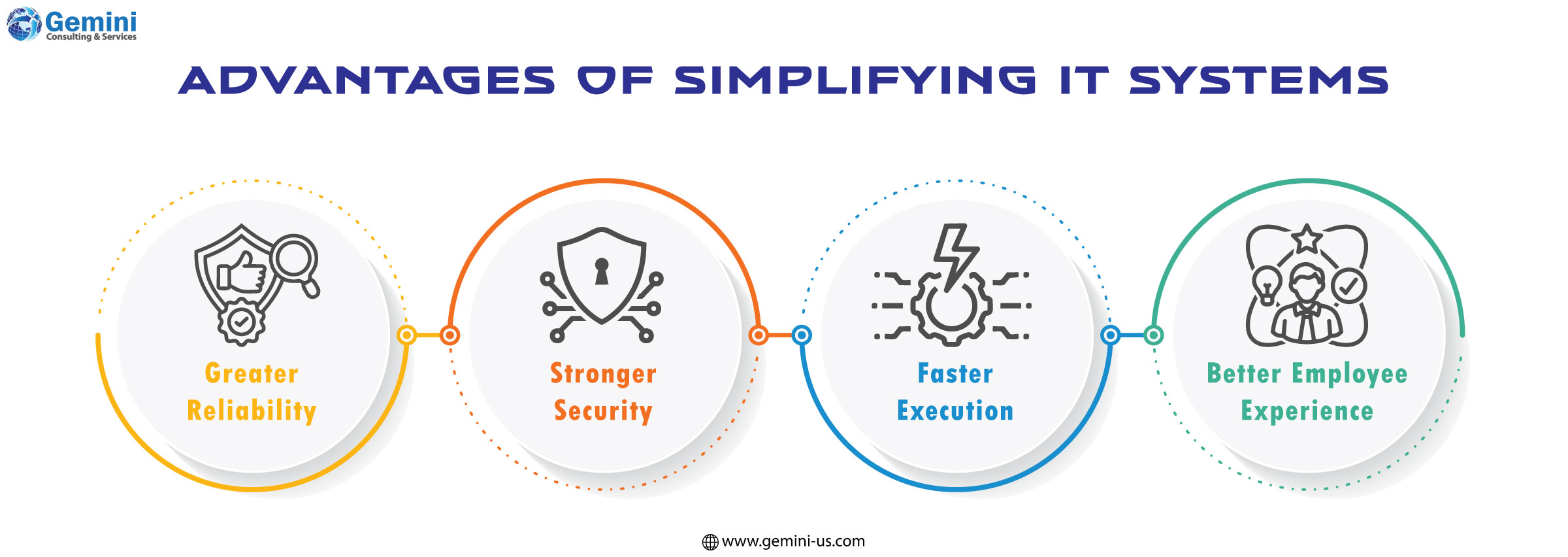
Greater Reliability
Systems with fewer moving parts generally experience fewer failures. Simplified architectures make it easier to identify issues, troubleshoot problems, and maintain operational stability.
Stronger Security
Complexity often creates vulnerabilities. Multiple integrations, disconnected platforms, and redundant applications expand the potential attack surface. Streamlined environments reduce risk and improve governance.
Faster Execution
Clear workflows and connected data enable teams to collaborate more effectively. Organizations can release new capabilities faster and respond more quickly to market changes.
Better Employee Experience
Simple systems are easier to learn and manage. Employees spend less time navigating complicated processes and more time creating value, reducing burnout while improving productivity.
The AI-Powered Simplicity Revolution
Artificial Intelligence (AI) is accelerating the shift towards simplicity.
Rather than requiring users to understand complex systems, AI enables natural interactions through conversational interfaces, automation, and intelligent recommendations. Routine configurations, administrative tasks, and technical operations can increasingly be handled behind the scenes.
This allows organizations to deliver sophisticated capabilities while hiding technical complexity from end users.
AI is also changing customer expectations. Consumers increasingly expect instant answers, personalized recommendations, and effortless self-service experiences. With AI set to change the IT landscape with enhanced user accessibility and improved products, simplifying IT systems becomes an imperative for enterprises to differentiate themselves in a marketplace.
Why Simplicity Is So Difficult
Although simplicity sounds appealing, achieving it is rarely easy.
Modern enterprises face constant pressure from multiple directions:
- Customers demand more features and personalized experiences.
- Regulators require stronger controls and compliance measures.
- Business units introduce new products and services.
- Technology teams adopt new platforms while maintaining legacy systems.
The result is a gradual accumulation of processes, approvals, integrations, and exceptions. Over time, organizations become trapped in a cycle where every problem is solved by adding something new rather than removing what is no longer necessary.
Creating simplicity requires a different mindset, one focused on deliberate reduction rather than continuous addition. If your organization needs a trusted partner to streamline complex IT environments and lower operating expenses, Gemini Consulting & Services is here to assist. Contact us to learn how our technology specialists can design and execute effective strategies that simplify your IT infrastructure, enhance operational efficiency, and support your business goals.
Areas Enterprises Must Simplify
1. Simplify Processes
Many business processes are collections of historical exceptions. Each incident, audit finding, or departmental requirement adds another step.
Instead of optimizing around approvals and checkpoints, organizations should focus on outcomes.
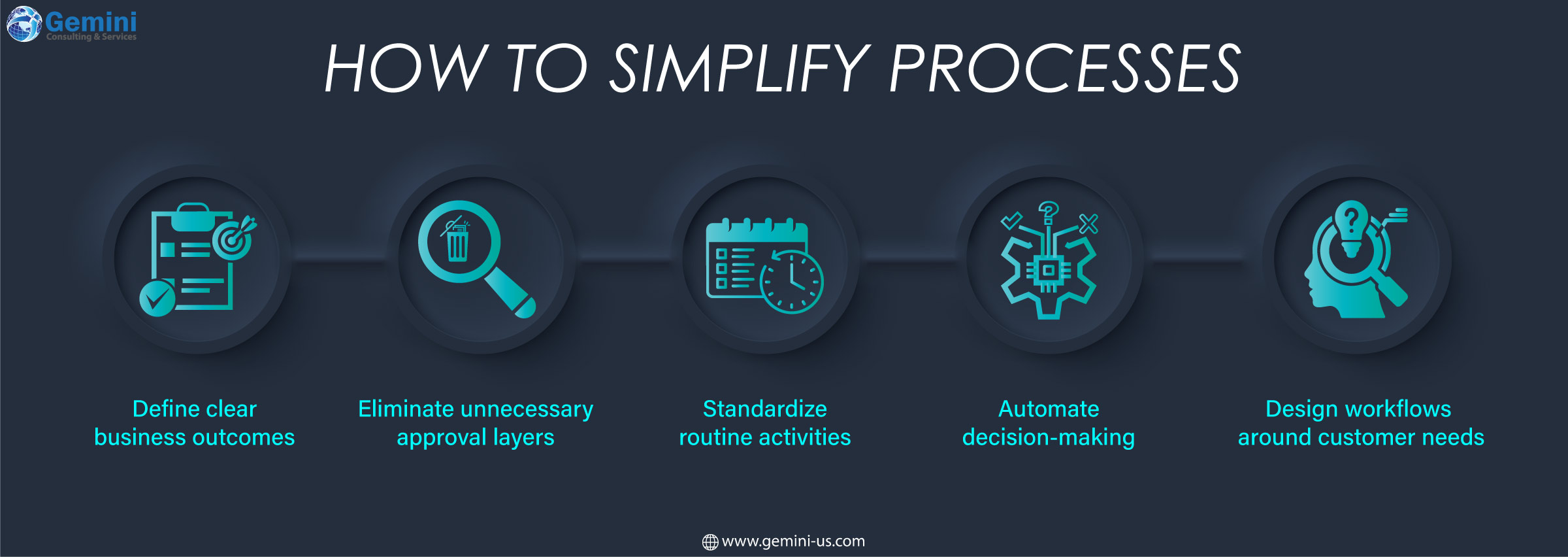
- Defining clear business outcomes
- Eliminating unnecessary approval layers
- Standardizing routine activities
- Automating decisions through data-driven policies
- Designing workflows around customer needs
Design thinking plays an important role here. The goal is not simply to create shorter processes but to create experiences that feel intuitive, predictable, and trustworthy.
2. Simplify Technology Architecture
Technology architecture often becomes a source of operational drag.
Large monolithic systems may appear stable, but they frequently slow innovation and make changes costly and risky. Modern enterprises increasingly benefit from modular architectures that encourage flexibility and ownership.
Key principles include:
- Domain-focused services
- API-first integration strategies
- Standardized data models
- Clear architectural governance
- Reduced dependency chains
- Retirement of obsolete systems
However, simplification does not mean adopting every modern trend. Replacing monoliths with hundreds of poorly managed microservices can create a different form of complexity. The objective is purposeful modularity, not technological excess.
3. Simplify Products and Services
Many organizations attempt to address every customer segment with a unique product, plan, or offering to improve satisfaction levels. But this can lead to confusion and additional manpower.
Modern product design should focus on:
- Clear value propositions
- Easy comparison between options
- Transparent pricing and benefits
- Personalized experiences without expanding product catalogs
Rather than creating hundreds of variations, organizations can use data and AI to personalize customer experiences around a smaller set of well-defined offerings.
The result is a better customer experience and a more manageable operating model.
4. Embrace Cloud-Native Technologies
Adopt cloud-native capabilities such as Secure Access Service Edge (SASE), container-based deployments, and serverless architectures. These technologies help streamline infrastructure operations, improve scalability, and lower the administrative burden on IT teams.
5. Transition from Monolithic Systems
Explore the use of microservices to modernize application development. Breaking applications into smaller, independent components enables teams to develop, deploy, and scale services more effectively while responding quickly to evolving business needs.
6. Implement Strategic Automation
Leverage automation for infrastructure deployment, software delivery, and system monitoring. Practices such as Infrastructure as Code (IaC) and Continuous Integration/Continuous Deployment (CI/CD) help standardize processes, increase efficiency, and reduce reliance on manual tasks.
Simplifying IT environments is an ongoing journey rather than a one-time initiative. Foster a culture of collaboration, involve stakeholders across teams, and recognize achievements along the way. Organizations that prioritize simplicity can improve operational performance, strengthen security, and build a stronger foundation for long-term growth and success.
The Reality of Building Simplicity
Simplification is not a cosmetic exercise. It requires strategic commitment and organizational discipline.
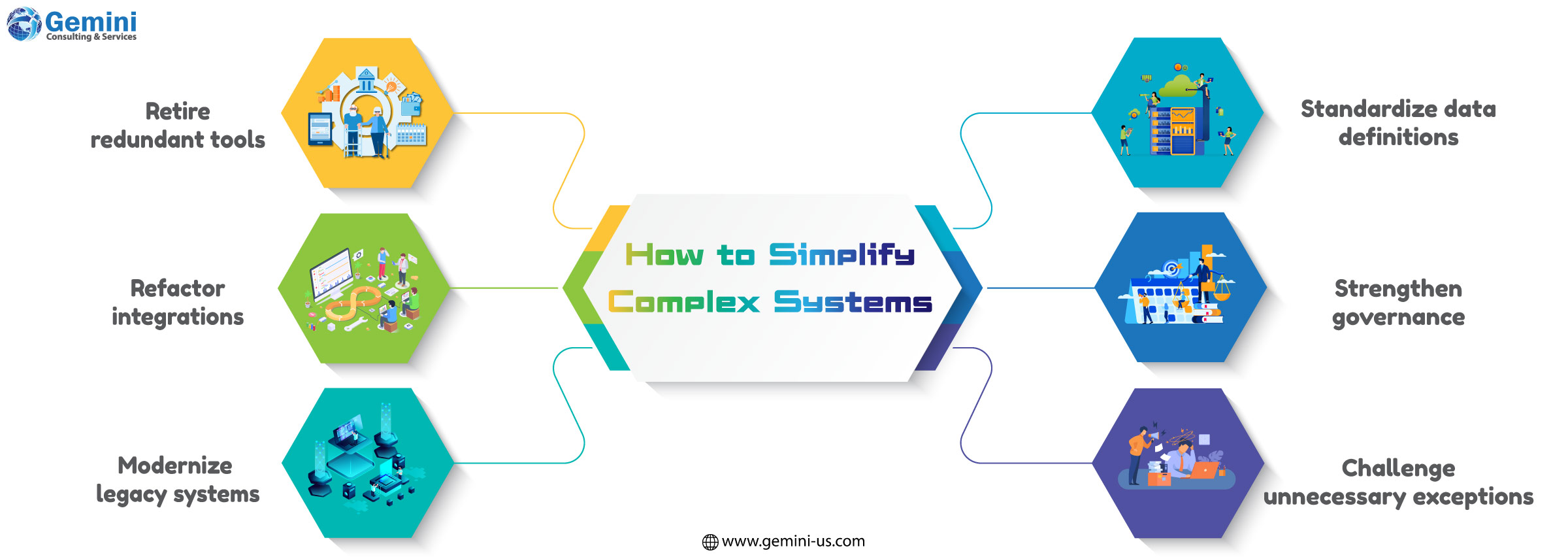
- Retire redundant tools
- Modernize legacy systems
- Refactor integrations
- Standardize data definitions
- Strengthen governance
- Challenge unnecessary exceptions
This work can be difficult because complexity often accumulates over many years. Yet the long-term rewards are substantial.
Enterprises that successfully simplify their operations typically experience:
- Faster time-to-market
- Lower operating costs
- Improved reliability
- Better customer satisfaction
- Higher employee productivity
- Greater adaptability to future change
A useful measure is the time required to implement a routine business change. When simple updates take weeks or months, complexity is often the underlying cause.
The Future Belongs to Simplicity
The most successful enterprises of the future will not necessarily be those with the largest technology stacks or the most sophisticated architectures. They will be the organizations that make powerful capabilities feel effortless for customers and employees alike.
Simplicity does not mean sacrificing capability, compliance, or control. Instead, it means delivering those capabilities in a way that reduces friction, accelerates change, and improves outcomes.
Paradoxically, achieving simplicity requires significant effort. It demands thoughtful design, disciplined engineering, and a willingness to eliminate what no longer adds value.
In a world where everything is increasingly accessible, comparable, and transparent, the organizations that feel simplest will often be perceived as the smartest. That is why simplicity is no longer just a design principle, it is becoming the defining strategy for modern enterprise success.