
For decades, supply chain leaders focused primarily on cost control and operational efficiency. While those priorities remain important, today’s volatile global environment has reshaped the agenda. Modern supply chain orchestration now demands cross-functional collaboration, real-time visibility, and seamless coordination with external partners.
In an economy defined by uncertainty, disruption, and rising customer expectations, companies that invest in digital supply chains position themselves for resilience, adaptability, and sustainable growth.
A Tough Balancing Act for Today’s Leaders
Supply chain executives are navigating an increasingly complex landscape. They must balance innovation, efficiency, sustainability, and transparency, all while delivering superior customer experiences.
Meeting Customer Expectations
Customers now expect faster delivery, personalized products, ethical sourcing, and real-time order visibility. The companies that win market share are those with highly responsive and well-orchestrated supply chains. Transparency is essential for enterprises.
Staying Agile Amid Disruption
From geopolitical shifts to sudden demand fluctuations, supply chain disruptions are now commonplace. Real-time data and actionable insights allow organizations to respond proactively rather than reactively. Agility depends on visibility and visibility depends on digitalization.
Minimizing Waste While Maximizing Performance
Efficiency remains critical. Automation, intelligent workflows, and predictive analytics reduce errors, shorten lead times, and enhance productivity. However, successful leaders understand that automation must be implemented thoughtfully, blending human expertise with intelligent systems.
What Is a Digital Supply Chain?
A digital supply chain integrates advanced technologies, data analytics, and connected platforms to optimize end-to-end operations, from product design and procurement to manufacturing, logistics, and after-sales service.
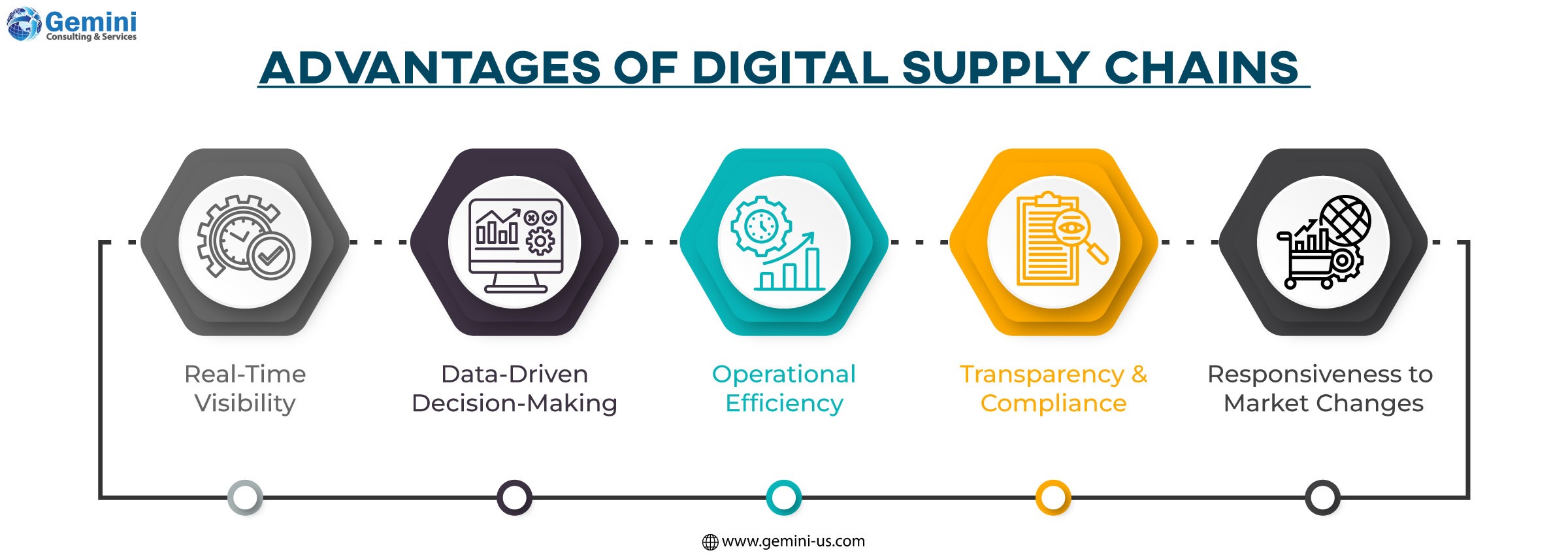
Rather than operating in isolated silos, digital supply chains connect internal departments and external partners through shared systems. This unified approach enhances the following.
By linking processes across the value chain, companies gain contextual intelligence that was previously unattainable.
While digital transformation may not be legally mandatory, failing to modernize can significantly undermine competitiveness.
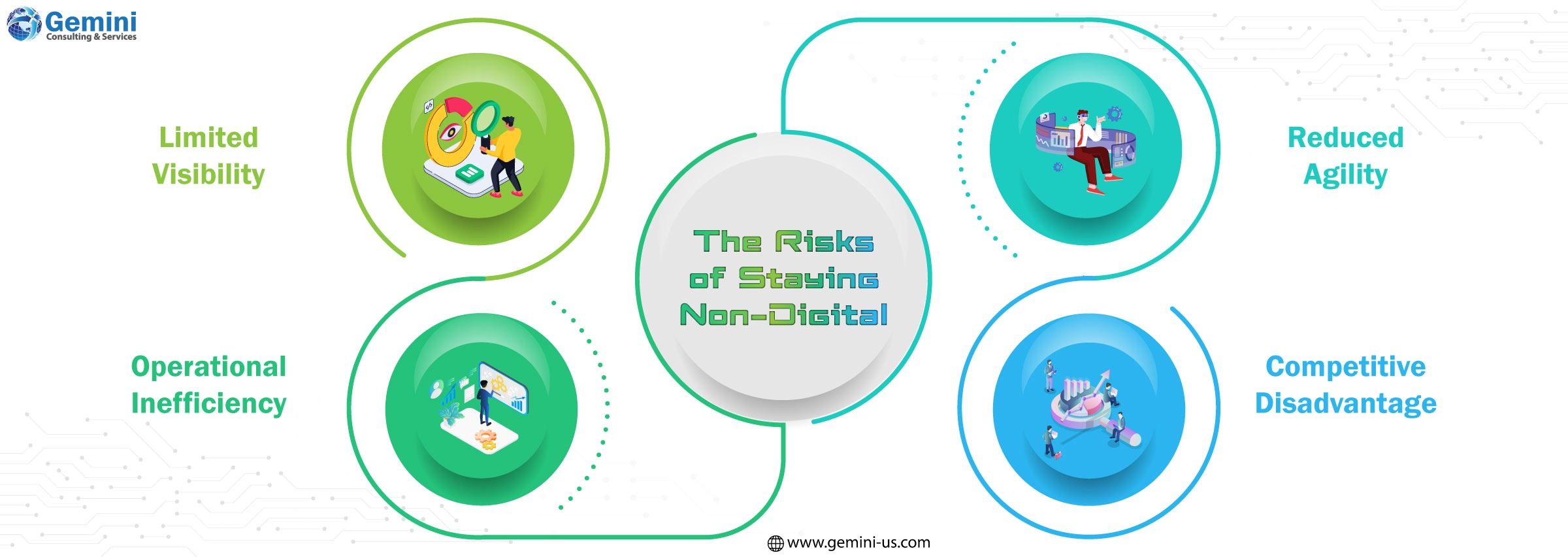
Limited Visibility
Without integrated systems, companies struggle to monitor inventory levels, demand shifts, and supplier performance. Blind spots increase risk exposure.
Operational Inefficiency
Manual processes often can be time consuming and prone to errors. Disconnected systems slow sourcing, procurement, manufacturing, and logistics.
Reduced Agility
In the absence of real-time data, organizations react slowly to market changes, leading to missed opportunities or costly overcorrections.
Competitive Disadvantage
Companies that delay digitization often fall behind competitors adopting AI, predictive analytics, and Internet of Things (IoT) technologies.
Sustainability and Compliance Risks
Environmental concerns play a major role in setting regulatory norms and customer expectations. Without digital tracking and reporting tools, measuring carbon footprints and sustainability KPIs becomes difficult and risky.
Sustainability: A Strategic Imperative
Sustainability is no longer solely about corporate responsibility. It directly impacts brand perception and market access. Customers favor environmentally responsible companies, and governments increasingly enforce strict regulations.
Digital supply chains enable:
- Carbon footprint tracking
- Energy optimization
- Responsible sourcing verification
- Transparent sustainability reporting
Environmental management systems help businesses measure and improve their sustainability performance while maintaining operational efficiency.
If your enterprise is seeking to tie up with a technology partner for building digital supply chain using SAP solutions, Gemini Consulting & Services can help you. Contact us to understand how our SAP experts can improve efficiency of your supply chain operations.
Why SAP Plays a Central Role
When discussing digital supply chains, SAP stands out as a leading provider of enterprise solutions that unify applications, data, and artificial intelligence into a single ecosystem.
Modern enterprise management requires more than isolated improvements. It demands integrated systems capable of coordinating finance, procurement, operations, HR, sales, and IT in real time.
SAP Business Suite: Breaking Down Silos
SAP Business Suite enables cross-functional collaboration by providing a unified backbone for mission-critical processes. Finance teams gain supply chain visibility. Operations align with procurement. HR adjusts workforce planning based on production forecasts.
This interconnected environment empowers C-suite leaders, from the COO to the CFO and CPO, to make informed, enterprise-wide decisions.
Intelligent Data and AI Integration
With AI-driven insight applications and intelligent agents, SAP systems can coordinate activities across departments. For example:
- A finance system can instantly evaluate cost impacts.
- A supply chain module can redirect shipments.
- Workforce systems can adjust staffing plans.
This real-time orchestration drives agility and resilience.
Key SAP Digital Supply Chain Solutions
1. Warehouse and Inventory Management
SAP Extended Warehouse Management (EWM) streamlines storage, picking, packing, and shipping processes. Automated tracking, RFID integration, and intelligent robotics enhance accuracy while reducing labor costs and fulfillment times.
2. Demand Planning and Forecasting
SAP Integrated Business Planning (IBP) leverages AI and historical data to generate precise forecasts. By analyzing market trends and demand patterns, businesses can dynamically adjust procurement and production strategies.
Improved forecasting reduces stockouts, lowers excess inventory, and strengthens supplier negotiations.
3. Supplier Collaboration
SAP Ariba centralizes procurement activities, enabling better contract management, supplier performance monitoring, and purchase order tracking. Enhanced collaboration fosters transparency and quicker responses to disruptions.
4. Sustainability and Safety Management
SAP Environment, Health, and Safety (EHS) supports regulatory compliance, risk management, and workplace safety initiatives while integrating sustainability reporting into broader enterprise processes.
The Value of ERP and SCM Integration
Supply chain management systems become exponentially more powerful when integrated with Enterprise Resource Planning (ERP). ERP centralizes data across finance, HR, manufacturing, and procurement.
When ERP and SCM systems operate together:
- Data silos disappear
- Decision-making becomes data-driven
- Process gaps and duplication are reduced
- Costs decline through improved coordination
This integration enhances execution while enabling strategic planning.
The Shift to Cloud-Based SCM
Cloud technology is transforming supply chain management by offering scalability, flexibility, and resilience. Companies can:
- Scale operations without heavy infrastructure investment
- Customize solutions to fit evolving needs
- Access secure backup and disaster recovery capabilities
- Gradually migrate systems without full-scale disruption
Cloud-based SCM also enhances collaboration across global networks, enabling faster information exchange among suppliers, manufacturers, and distributors.
A Technical Perspective for Students and Future Leaders
For students exploring supply chain management, understanding SAP’s role is essential. At its core, SAP emphasizes effective data management, the backbone of supply chain success.
Through modules such as:
- Advanced Planning and Optimization
- Forecasting and Replenishment
- Event Management
- Supply Network Collaboration
- Transportation Management
SAP enables real-time tracking, detailed analytics, and seamless integration with IoT technologies. Dashboards and reporting tools provide actionable insights that improve both strategic planning and operational control.
Final Thoughts: A Bold Shift Is Required
Incremental improvements are no longer sufficient. The complexity of modern markets demands a bold transformation toward integrated, AI-enabled, cloud-powered supply chains.
Digital supply chains provide:
- Enhanced visibility
- Faster decision-making
- Greater agility
- Improved sustainability
- Stronger collaboration
Organizations that invest in intelligent platforms such as SAP not only streamline operations but also empower leaders to drive innovation and long-term growth.
In a world of constant disruption, resilience is the new competitive advantage, and digital supply chain transformation is the pathway to achieving it.