
Organizations across industries are gradually modernizing their SAP landscapes to support a more dynamic financial environment. As the volume of financial data grows and market conditions change rapidly, businesses need systems that can evolve alongside these developments.
Traditional SAP environments were designed to manage structured accounting processes and stable financial workflows. However, the modern financial ecosystem demands far greater flexibility. Companies now expect SAP platforms to handle a wider range of data sources while maintaining strong governance and accuracy. As a result, enterprises are redesigning their SAP infrastructures to support faster data processing and more diverse financial inputs.
Why Digital Finance Is Transforming Enterprise SAP
Digital finance has moved far beyond experimentation and has become an integral part of modern business operations. Innovations such as digital payment networks, tokenized assets, and instant settlement systems have reshaped how financial data is created and exchanged.
These advancements introduce new layers of complexity for enterprise systems. Financial platforms must now process real-time information from both internal operations and external markets. This shift is not limited to a specific region—it is happening globally. Organizations in Europe, Asia-Pacific, Africa, and the Americas all face the challenge of managing larger volumes of financial data at higher speeds.
Market indicators—from traditional economic signals to emerging digital asset prices—illustrate how rapidly financial conditions can change. As digital finance continues to evolve, SAP systems are expanding their role beyond basic accounting. They are increasingly expected to provide timely financial insights that support strategic decision-making.
Building SAP Architectures That Handle Market Volatility
In today’s global economy, volatility has become a constant rather than an exception. Enterprise systems must therefore be designed with adaptability in mind.
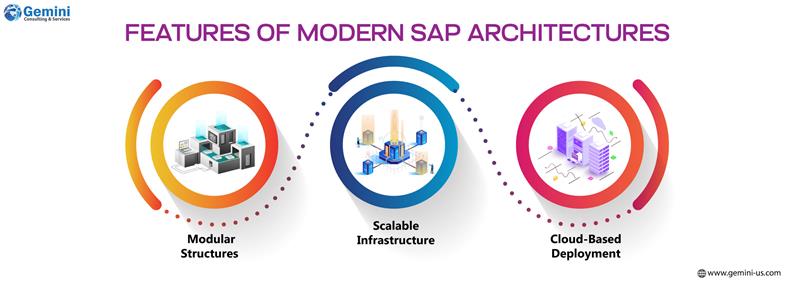
Modern SAP architectures emphasize modular structures and scalable infrastructure. Modular design allows organizations to update or replace individual components without disrupting the entire system. At the same time, scalable environments ensure that the platform can accommodate fluctuations in data volume and processing demand.
Cloud-based SAP deployments play an important role in this shift. Cloud infrastructure allows businesses to expand computing resources when demand increases and reduce them when it declines. This flexibility enables SAP environments to respond efficiently to changing financial conditions.
Integrating External Financial Signals Without Disrupting Core Systems
Many enterprises now rely on external financial indicators to guide their operations. These signals may include exchange rates, commodity prices, digital asset values, or broader market trends.
However, integrating such information directly into core SAP processes can create performance and stability risks if not handled carefully. To avoid these issues, organizations are redesigning how external data enters their systems.
One effective approach is separating core transactional systems from analytical processing layers. External data can first be collected through dedicated interfaces and processed in analytical environments. The resulting insights are then mapped to SAP data models in a controlled way.
This structure ensures visibility into external market conditions without compromising the integrity of financial records. It also allows organizations to experiment with new data sources without constantly restructuring their core SAP environments.
Governance, Security, and Control in a Data-Driven SAP Landscape
As SAP platforms manage larger and more diverse data sets, governance becomes increasingly important. The more data organizations collect, especially from external sources, the greater the need for clear oversight and accountability.
Many companies are strengthening governance frameworks within their SAP environments. Role-based access controls help ensure that only authorized users can access sensitive financial information. Audit trails provide transparency into how data is used and modified, while data lineage tools help organizations understand where information originates and how it flows through the system.
Security is another critical consideration. Integrating external data introduces additional risks, making secure interfaces and strict validation mechanisms essential. By implementing strong security practices, organizations can maintain data integrity while still enabling innovation.
In this context, governance is no longer viewed as a barrier to progress. Instead, robust controls create a stable foundation that allows businesses to safely explore new financial data sources and technologies.
If your enterprise is planning to restructure the existing SAP ecosystem or looking to deploy a new SAP system that can meet the dynamic market environment of digital finance, Gemini Consulting & Services can help you. Contact us to know how our SAP experts can provide an efficient roadmap for digital transformation.
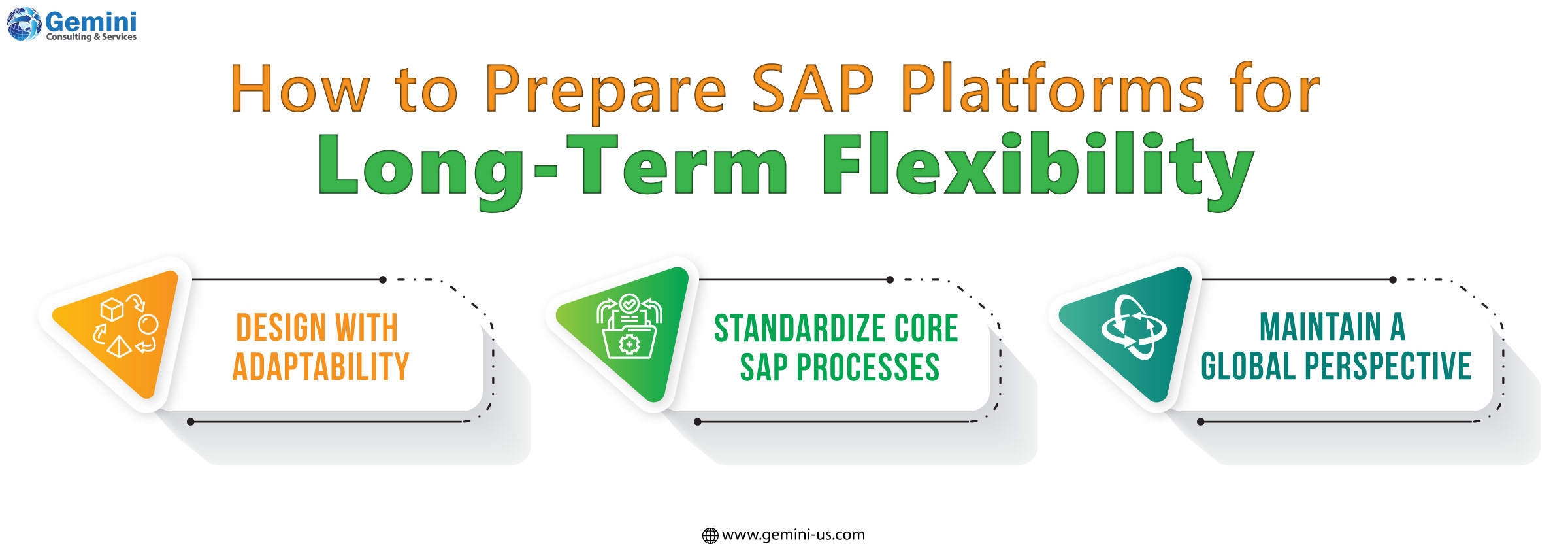
To remain effective in the future, SAP systems must be designed with adaptability in mind. Financial platforms need to accommodate evolving technologies, regulatory requirements, and market conditions.
Many enterprises are now focusing on standardizing their core SAP processes while maintaining flexibility at the system’s edges. This approach ensures operational stability while allowing organizations to introduce new tools, analytics models, or data sources without major disruptions.
A global perspective is also essential. SAP platforms must support multiple currencies, regulatory frameworks, and operational environments across different markets. Therefore, modern architectures emphasize interoperability, resilience, and scalability.
Ultimately, future-proofing SAP is not about predicting every technological trend. Instead, it is about building systems capable of adapting to change itself, ensuring that enterprise platforms remain relevant as digital finance continues to evolve.