
Inventory plays a critical role in supply chain planning within SAP S/4HANA because all logistics and planning activities rely on how stock is categorized, controlled, and moved across the organization.
In SAP S/4HANA, inventory is structured using stock types and special stock types. These classifications determine how materials are used, who owns them, how they are valued, and where they are stored within the organization. They support key business processes such as procurement, manufacturing, and distribution. A clear understanding of these stock categories, such as quality inspection stock, consignment stock, project stock, and stock in transit, helps organizations manage material flow efficiently, control costs, and ensure smooth operations.
Inventory represents all materials involved in business processes. Depending on the nature of the product, inventory can include raw materials, semi-finished goods, Work in Process (WIP), finished goods, and spare parts. These materials are further divided into stock types, which define how inventory behaves within the system. SAP S/4HANA allows the configuration of numerous stock types (up to around 60), each specifying usage rules, valuation methods, and organizational levels.
Technically, stock types are identified in the system through specific fields such as Stock Type and Special Stock Type, along with additional keys. These combinations provide insight into how inventory is managed and processed.
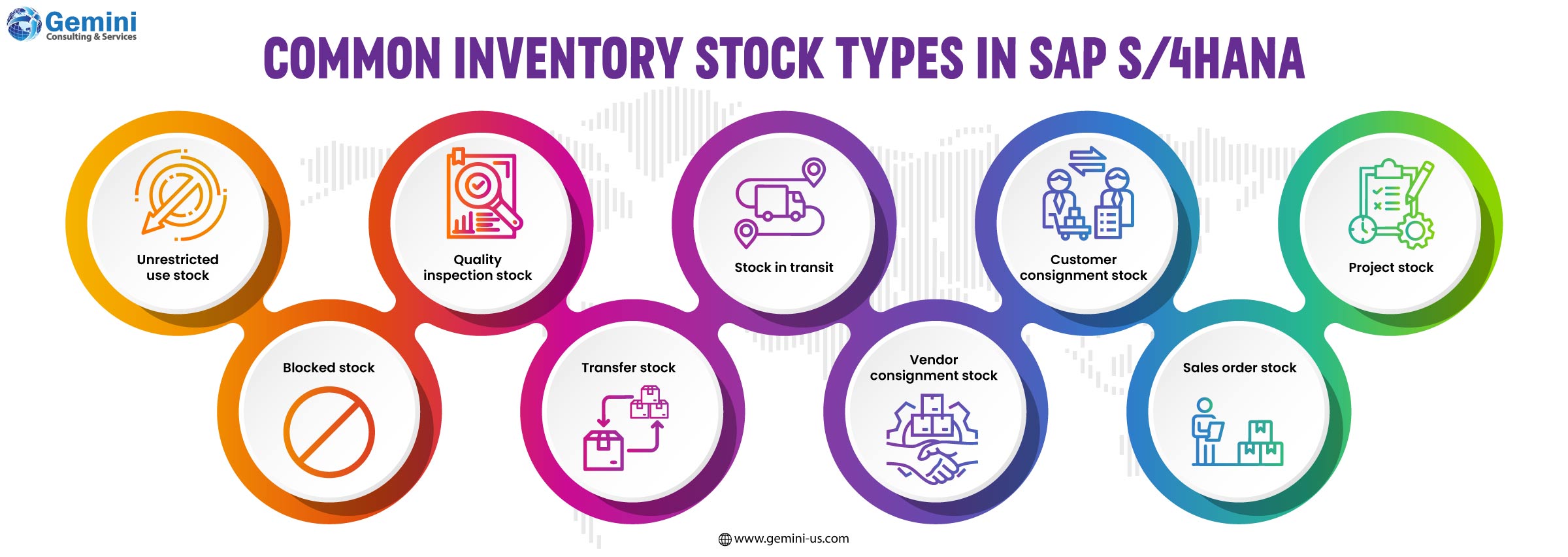
Some of the most frequently used stock types include:
- Unrestricted-use stock: Available for any business activity.
- Blocked stock: Cannot be used, except for internal transfers.
- Quality inspection stock: Held for quality checks, often integrated with quality management processes.
- Transfer stock: Moving between organizational units in a controlled process.
- Stock in transit: Being transported but not yet available for use.
- Vendor consignment stock: Owned by the supplier but usable by the organization.
- Customer consignment stock: Owned by the company but stored at the customer’s location.
- Sales order stock: Inventory set aside to fulfil a particular customer order.
- Project stock: Assigned to a particular project.
Some stock types are industry-specific, such as retail returnable packaging or subcontracting stock. Additionally, certain stock types exist only at specific organizational levels, for example, some are tracked at plant level, while others are managed at storage location level.
Non-Inventory Stock Categories
There are also stock-related elements that are not directly managed within inventory, such as:
- Reservations
- Goods receipt blocked stock (non-valuated)
Role of Stock Transitions in Business Processes
The movement between different stock types reflects the underlying logistics processes. For example, a company may receive semi-finished goods as vendor consignment stock, inspect them under quality stock, and then move them into unrestricted stock after approval. These materials might then be issued to a subcontractor and finally returned as finished goods.
Such transitions illustrate how inventory status changes define and track the lifecycle of materials across the supply chain.
Inventory and the Supply Chain
The movement of inventory across an organization forms the supply chain. Inventory can be sourced externally, produced internally, or handled through subcontractors. It is consumed during production and ultimately delivered as finished goods to customers.
An effective supply chain balances cost efficiency with service quality. Inventory-related costs include procurement, production, storage, and distribution. Businesses aim to minimize these costs while still meeting customer demand reliably.
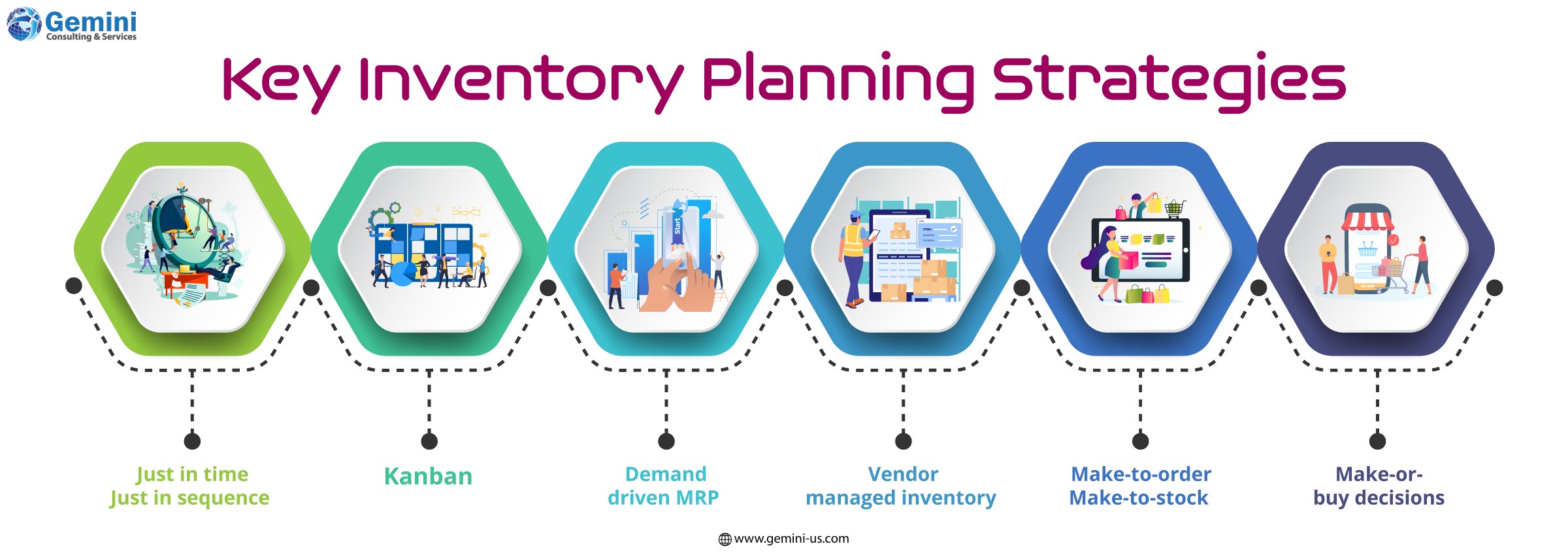
Organizations can adopt several strategies in SAP S/4HANA to optimize inventory:
- Just in Time (JIT) / Just in Sequence (JIS): Ensures materials arrive exactly when needed, commonly used in automotive manufacturing.
- Kanban: Uses visual signals and fixed container sizes to trigger replenishment.
- Demand-Driven MRP (DDMRP): Focuses on buffering and decoupling supply chain stages to reduce variability.
- Vendor-Managed Inventory (VMI): Transfers responsibility for stock management to suppliers.
- Make-to-Order (MTO) / Make-to-Stock (MTS): Aligns production with either actual demand or forecasts.
- Make-or-Buy Decisions: Determines whether to produce internally or outsource.
Conclusion
In SAP S/4HANA, inventory acts as the backbone of supply chain operations, connecting procurement, production, and sales. Gemini Consulting & Services can help your enterprise in understanding stock types and special stock types that indicate where materials are located but also define their usability, ownership, and financial impact. Contact us to organize inventory effectively and applying suitable planning strategies such as JIT, Kanban, or MTS, businesses can improve efficiency, reduce costs, and build a more resilient supply chain.