
In today’s fast-changing enterprise IT environment, SAP systems play a critical role in ensuring business stability, adaptability, and innovation. However, managing these systems, especially performing landscape refreshes, continues to be one of the most complex and resource-heavy responsibilities for SAP teams and service delivery organizations.
System refreshes are essential because they keep non-production environments aligned with production systems. This alignment supports development, testing, analytics, training, and compliance needs. Despite their importance, traditional refresh processes are often manual, inconsistent, and time-consuming. These challenges can result in delays, higher error rates, data inconsistencies, and even operational disruptions.
From a service delivery standpoint, automation is no longer just a way to improve efficiency, it has become a key driver of consistency, quality, and reliability across SAP environments.
Why Automation Matters in SAP Refresh Activities
Refreshing an SAP landscape involves multiple steps such as copying production data, adjusting configurations, managing authorizations, and validating system integrity. When performed manually, these tasks require deep expertise, careful coordination, and significant effort, increasing the likelihood of delays and mistakes.
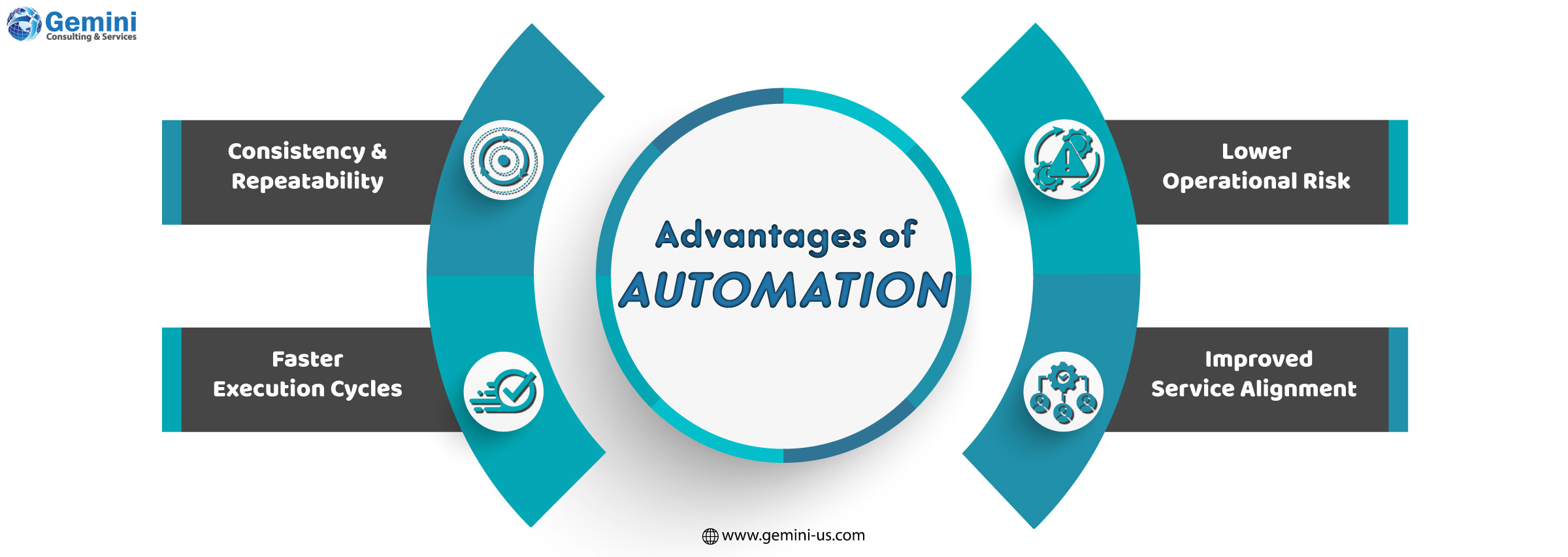
- Consistency and repeatability – Tasks execute uniformly every time
- Faster execution cycles – Reducing refresh timelines significantly
- Lower operational risk – Minimizing human intervention and errors
- Improved service alignment – Enabling IT teams to contribute directly to business outcomes
Modern best practices encourage the use of automated pipelines for recurring activities like system copies and refreshes. These pipelines improve reliability while enhancing speed and agility.
Moving Beyond Scripts to Full Orchestration
Automation is most powerful when it goes beyond isolated scripts and evolves into a coordinated, end-to-end process.
In SAP refresh scenarios, this includes:
- Task Automation: Handling repeatable steps such as database restoration, client setup, transport resets, and security updates
- Process Orchestration: Linking tasks into structured workflows that respect dependencies (e.g., disabling jobs before refresh and validating connections afterward).
- Governance integration: Embedding compliance measures like data masking and policy enforcement within the process
A mature automation strategy transforms standalone tools into reusable, scalable services. This not only accelerates refresh cycles but also opens the door to self-service capabilities and improved lifecycle management.
Shifting from Execution to Strategic Service Delivery
Organizations today expect more than just faster execution. They demand reliability, scalability, and quality assurance. Automation helps redefine the role of service delivery teams in three important ways.

1. Predictable Outcomes Instead of Reactive Work
Automated pipelines ensure consistent results regardless of team changes, allowing teams to focus on improvement rather than troubleshooting.
2. Built-In Data Governance
Compliance requirements, including data privacy and masking, are automatically enforced, which is especially critical in regulated industries.
3. Scalable Operations
As SAP landscapes expand, automation enables teams to replicate processes easily without relying on custom scripts or undocumented knowledge.
This transformation aligns IT services with business priorities, where success is measured by dependable delivery and support for organizational goals.
Example: Advanced Refresh Automation in Practice
Imagine a scenario where:
- A refresh cycle is triggered automatically based on a defined schedule
- Infrastructure is provisioned using Infrastructure as Code (IaC)
- Data protection policies are applied during execution
- Validation checkpoints confirm system readiness before completion
Such an approach not only reduces turnaround time but also provides measurable insights like success rates, error trends, and delivery performance.
Unlike traditional scripting, this model integrates governance, monitoring, and control into the entire process, making automation a core part of service delivery.
Turning Theory into Measurable Impact
The true value of automation becomes evident in real-world implementations. Organizations that adopt end-to-end automation for SAP refreshes often experience significant improvements in efficiency, accuracy, and delivery timelines.
These transformations demonstrate how automation can fundamentally change the way SAP operations are executed and managed.
If your enterprise is looking for a technology partner to automate SAP landscape, Gemini Consulting & Services can help you. Contact us to consult with our experts on how to automate SAP systems with accuracy and efficiency.
Overcoming Adoption Challenges
Despite its advantages, implementing automation is not without obstacles. Common challenges include:
- Legacy systems and disconnected tools
- Limited expertise in orchestration and pipeline design
- Hesitation to automate critical processes due to trust concerns
To address these, leaders should:
- Focus on standardized frameworks instead of one-off solutions
- Encourage collaboration across Basis, cloud, DevOps, and compliance teams
- Build trust through continuous validation, monitoring, and rollback mechanisms
The objective is to create automation that is not only efficient but also reliable and adaptable.
Leading Through Automation
Automating SAP landscape refreshes is more than an operational improvement, it represents a shift towards modern, outcome-driven IT service delivery.
For organizations undergoing SAP transformation, automation is no longer optional. It is a necessity for achieving consistency, compliance, and speed at scale.
Leaders play a crucial role in enabling this shift by establishing the right frameworks and strategies. When automation is embraced as a core capability rather than just a technical tool, it unlocks greater agility, stronger governance, and increased confidence in IT operations.